
The news in Polish
Polski rząd zastanawia1 się, czy dołączyć do programu SAFE Unii Europejskiej. Program daje duże, tanie kredyty na nowoczesną2 broń i sprzęt3 wojskowy. Zwolennicy4 mówią o większym bezpieczeństwie i nowych miejscach pracy w Polsce. Przeciwnicy5 boją się wysokiego długu i zależności6 od UE. Decyzję ma podjąć prezydent.
- zastanawiać się
myśleć nad czymś, rozważać różne możliwości przed podjęciem decyzji ↩︎ - nowoczesny
zgodny z najnowszą techniką lub modą; współczesny i rozwinięty ↩︎ - sprzęt (m.)
zestaw narzędzi, urządzeń lub maszyn potrzebnych do jakiejś działalności ↩︎ - zwolennik (m.)
osoby popierające jakiś pomysł, plan lub osobę ↩︎ - przeciwnik (m.)
osoby, które są przeciwne jakiemuś pomysłowi, planowi lub osobie ↩︎ - zależność (f.)
sytuacja, kiedy ktoś lub coś musi liczyć na pomoc lub decyzje kogoś innego ↩︎
Translation
Text comprehension
Question 1: What can Poland get from the SAFE programme if it joins?
Question 2: Why are some people in Poland against joining the SAFE programme?
Vocabulary
| Polish | English |
|---|---|
| zastanawiać się | |
| nowoczesny | |
| sprzęt (m.) | |
| zwolennik (m.) | |
| przeciwnik (m.) | |
| zależność (f.) | |
Free trial lesson
Curious about live learning? Join a free trial lesson and see what it’s like to learn with us. No commitment, no pressure – just a friendly session to find out if it’s the right fit for you.
Reserve your spot
Read the full story
The Polish government is weighing whether to join the European Union’s new SAFE defence financing programme, a move that could bring Poland up to 180 billion złoty (around 43–44 billion euro) in low-interest loans for military modernisation. The plan has triggered intense discussion among politicians, experts and ordinary citizens, especially in regions linked to the defence industry.
SAFE – short for Security Action for Europe – was launched by the EU in 2025 in response to growing security concerns, particularly the threat from Russia and uncertainty over the long-term role of the United States in European defence. The programme offers up to 150 billion euro in loans to EU member states for buying military equipment, mainly produced in Europe, on relatively favourable terms.
Under the rules, participating countries can purchase a wide range of priority defence products. These include ammunition and artillery systems, armoured vehicles and infantry weapons, drones and anti-drone systems, air and missile defence, naval capabilities, and high-tech systems such as C4ISTAR command networks, satellite assets, cyber and electronic warfare tools. At least 65 per cent of the value of components must come from the EU, the European Economic Area or Ukraine, but up to 35 per cent can be sourced elsewhere.
Poland has already submitted a list of 139 projects worth around 43.7 billion euro, which corresponds to about 185 billion złoty. According to the Ministry of Defence, much of this money would finance air and missile defence and systems to protect against drones. Planned purchases include a major anti-drone shield costing roughly 15 billion złoty, new radar systems, Piorun anti-aircraft launchers, and various types of reconnaissance and strike drones. Funds would also support “Tarcza Wschód” (East Shield), a project to strengthen Poland’s eastern border with advanced sensors, radars and engineering systems such as Baobab mine-laying vehicles.
A significant part of the proposed spending would go to Polish defence manufacturers. This includes factories producing Krab self-propelled howitzers, Rak mortars and Borsuk infantry fighting vehicles in the industrial city of Stalowa Wola, as well as Rosomak armoured personnel carriers in Siemianowice Śląskie. The government also plans to use SAFE to co-finance foreign technologies that Poland does not yet produce, such as Airbus A330 MRTT air-to-air refuelling aircraft, training and combat helicopters, and a geostationary observation satellite. Polish companies would be involved in associated equipment, including satellite terminals and synthetic-aperture radar (SAR) observation systems.
The programme is not limited to the regular armed forces. Around 8 billion złoty is earmarked to modernise other uniformed services, including the police, Border Guard and the Government Protection Service (SOP). Planned investments include equipment for countering drones, as well as vessels for Baltic Sea security, such as rescue ships, hydrographic vessels and minehunters.
Financial conditions are a central argument in the debate. Because the loans are taken out by the European Commission, which has a high credit rating (AA+), the interest rate negotiated with financial institutions is reported to be around 3–3.3 per cent. According to EU budget commissioner Piotr Serafin, there is a 10-year grace period during which countries pay only interest, not the loan principal. The repayment period can extend up to 45 years, making it a very long-term commitment. These terms are attractive for some states, but others, such as Germany, Sweden, the Netherlands and Luxembourg, have higher ratings and can often borrow even more cheaply on their own, which is one reason they have not joined SAFE.
Within Poland, the proposed participation in SAFE still awaits final approval. The Sejm (lower house of parliament) has passed the implementing law, and the Senate has added several amendments. One key change specifies that SAFE loan servicing costs will not count towards Poland’s legally required minimum defence spending, while another introduces mandatory anti-corruption and counter-intelligence oversight by agencies such as the Internal Security Agency (ABW), Military Counterintelligence Service (SKW) and Central Anti-Corruption Bureau (CBA). The Senate also expanded reporting duties, requiring more detailed information on how funds are used.
The law now lies on the desk of President Karol Nawrocki, who has 21 days to decide whether to sign it, veto it or send it to the Constitutional Tribunal for a so-called subsequent review of its compatibility with the constitution. The president has called the issue “very important” and said he is consulting military commanders, the government and his own National Security Bureau while also observing public reactions. He has so far avoided stating clearly what he will do.
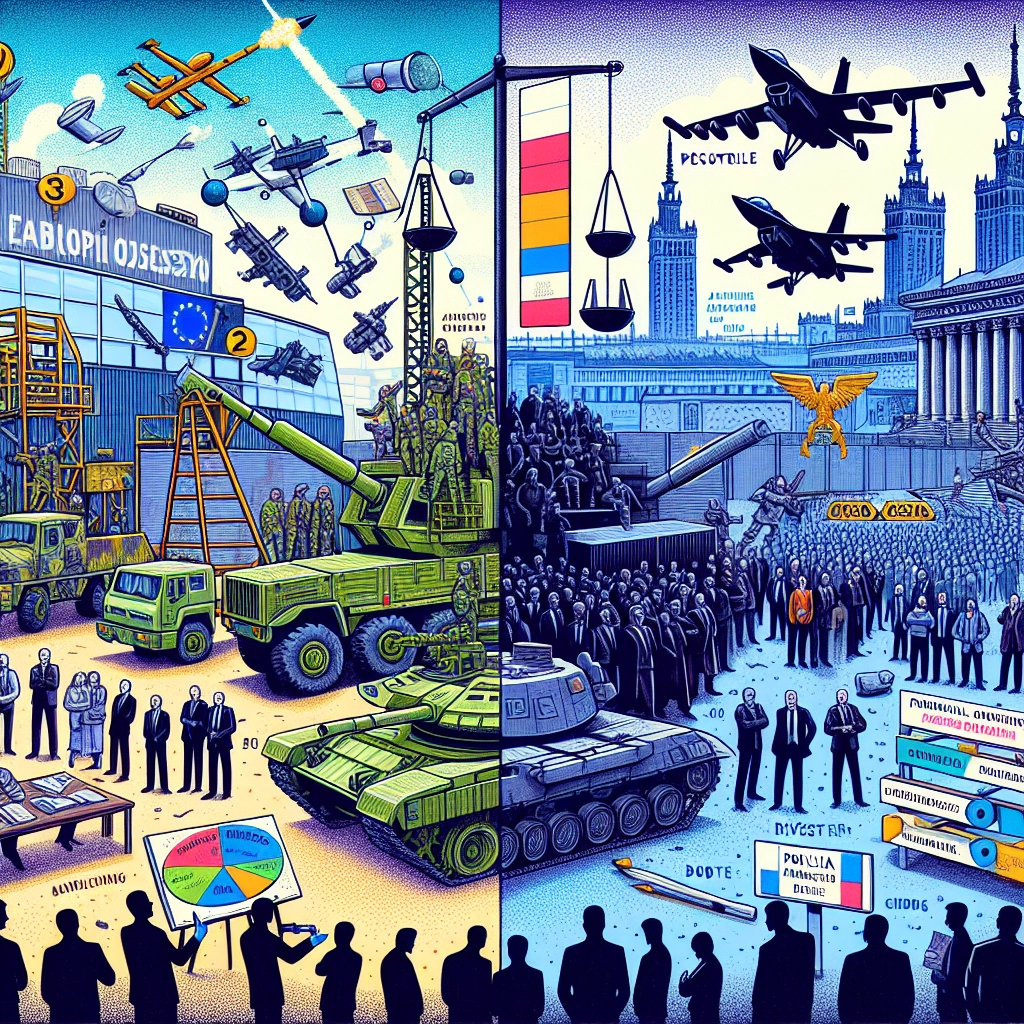
In the political arena, the ruling coalition – including Civic Coalition, the Left, PSL and Poland 2050 – strongly supports joining SAFE. Prime Minister Donald Tusk describes it as a key instrument to strengthen both Poland’s security and its defence industry. At an event in Kobyłka near Warsaw, at the facilities of defence electronics firm PIT-RADWAR, he argued that Poland itself helped design the programme and push it through at EU level. According to him, SAFE was “from start to finish” a Polish initiative aimed at convincing other member states to invest much more in defence.
Tusk has tried to counter what he calls three main “myths” surrounding SAFE. The first is that it would threaten Polish sovereignty. He insists the programme instead enhances sovereignty by improving defence capabilities and was not imposed by foreign actors. The second is the idea of “conditionality” – fears that access to funds might be used by EU institutions to influence Polish domestic politics. Tusk says the only conditions built into SAFE concern protecting EU money from corruption or misuse, and he argues that such safeguards should be welcomed, including by the opposition, as a tool to keep any government accountable.
The third issue is the claim that the main beneficiary would be German industry. The prime minister cites government calculations that more than 80 per cent of the funds would go to Polish entities, supporting an estimated 12,000 domestic companies connected to the defence sector. He estimates that firms from Germany would receive only around 0.37 per cent of the total, and even this would involve a Swedish-German joint venture rather than purely German suppliers. Tusk argues that SAFE will provide a powerful stimulus to the Polish economy and high technologies, including satellites, cyber security and advanced drone systems, and that it will not reduce Poland’s parallel defence cooperation with the United States or South Korea.
Defence Minister and deputy prime minister Władysław Kosiniak-Kamysz calls SAFE a “patriotic, not political” programme and says it is strongly desired by Polish soldiers. He describes it as potentially the largest and fastest transformation of Poland’s armed forces in the country’s modern history. In his view, the long-term financing would stabilise the army’s budget across future electoral cycles, while the fact that SAFE-funded purchases will not be paid from the Defence Ministry’s own budget would free national funds for other priorities, including ongoing contracts with non-European partners. He also notes that purchases made with SAFE loans are exempt from value-added tax (VAT), which in practice increases the volume of equipment that can be bought for the same nominal amount.
On the other side, the main opposition party Law and Justice (PiS) and the smaller Confederation group voted against the SAFE law in parliament. PiS parliamentary leader Mariusz Błaszczak has argued that the programme could act like a “chain” keeping states that pursue an independent policy under pressure from EU institutions. PiS politicians warn about the scale of the debt and its long repayment horizon of up to 45 years, raising concerns that future generations will bear the burden. They also point to the broader EU debate on the rule of law, suggesting that even if SAFE’s formal conditions focus on the proper use of funds, there is a risk of political leverage in the future. Critics inside PiS also note that Poland has already committed to very high defence spending – currently around 170–190 billion złoty a year – and question whether taking on additional EU debt is necessary to maintain and develop the domestic arms industry.
The discussion is also visible in Stalowa Wola, a city in south-eastern Poland that hosts one of the country’s most important arms factories, producing systems such as Krab, Rak and Borsuk. For many residents there, defence policy is not an abstract issue but directly connected to local jobs and income. Some citizens interviewed on the streets welcome the SAFE proposal, emphasising that it could bring more employment, higher wages and greater security. Supporters see a direct link between investment in the army and economic benefits for the region. They argue that, given the current international situation, Poland should strengthen its defences and that the EU loan terms look favourable.
Others in the same city are more cautious or downright sceptical. They question how much further Poland should go into debt, and some mention the example of Greece, which had to sell key assets after its debt crisis, as a warning. Long repayment periods raise fears that today’s decisions will be paid for by today’s children decades later. A retired worker from the local steelworks points out that the factory has survived earlier difficult times without such EU mechanisms and believes the industry could manage again without additional borrowing. These residents do not reject the idea of a strong army, but they are worried about the scale of the financial commitment.
There are also people who admit they do not follow the details of complicated multi-billion-euro programmes and focus instead on everyday concerns such as rising living costs. For them, the SAFE debate remains a distant argument between politicians in Warsaw and Brussels, even if the consequences may eventually touch their local factories and public services.
Across Europe, 19 EU member states have expressed interest in SAFE, although they are at different stages of approval. Some, like Belgium, Denmark, Spain, Croatia, Portugal and Romania, have already received the green light for their plans. Poland belongs to a second wave together with Estonia, Greece, Italy, Latvia, Lithuania, Slovakia and Finland. Other countries – including Czechia, France and Hungary – are still waiting for final approval, while several states with strong credit ratings have chosen not to participate at all.
As President Nawrocki considers his decision, Poland’s debate over SAFE remains intense. Proponents focus on the opportunity to rapidly modernise the army, support domestic industry and draw on relatively cheap European financing. Opponents emphasise debt, long-term obligations and potential political risks associated with EU conditionality. The outcome will influence not only Poland’s defence capabilities and industrial policy in the coming decades, but also its role within broader European security cooperation.
Info: ‘Polish Learner News’ is a service from ‘Let’s Learn Polish’, a Polish language school offering various types of online Polish courses. We provide structured learning resources and updates to help learners systematically improve their Polish.
Advanced: Reports from Poland
- SAFE: Billions for Defense, Years of Debt. What Do the Residents of Stalowa Wola Think? (Fakt.pl)
- What Is the SAFE Program? Key Questions and Answers (TVN24.pl)
- Karol Nawrocki Has 21 Days to Decide on SAFE: “He’ll Do Something, However Half‑Hearted” (Onet.pl)
- Emotions Run High Over SAFE Program: Donald Tusk Talks of “Three Myths” (Interia.pl)
Polish Learner News
Discover news from Poland to stay informed and practise your skills.
-

Learner News | 10.05.2026
Fatal jet ski crash at Polish championships
-

Learner News | 28.04.2026
Polish Livestream Shatters Record For Cancer Charity
-
Learner News | 28.04.2026
EU Parliament weighs lifting Kamiński immunity