
The news in Polish
- puszcza (f.)
duży, gęsty las, często pierwotny i dziki ↩︎ - nagrać
zarejestrować obraz lub dźwięk za pomocą kamery lub urządzenia nagrywającego ↩︎ - żubr (m.)
duże dzikie zwierzę z rogami, żyjące w lasach Europy ↩︎ - cielę (n.)
młode zwierzę, na przykład młody żubr lub krowa ↩︎ - bronić
chronić kogoś lub coś przed niebezpieczeństwem lub atakiem ↩︎ - polować
szukać i ścigać zwierzęta, aby je złapać lub zabić ↩︎
Translation
Text comprehension
Question 1: How many wolves attempted to catch the calf?
Question 2: How did the bison defend the calf?
Vocabulary
| Polish | English |
|---|---|
| puszcza (f.) | |
| nagrać | |
| żubr (m.) | |
| cielę (n.) | |
| bronić | |
| polować | |
Already know some Polish?
Take our free placement test and find your current level in just a few minutes. It’s fun, fast, and helps you understand exactly where you are – and what the next step in your learning journey might be.
Take the free test
Read the full story
A remarkable camera trap recording made in Białowieża Forest has challenged long-held assumptions about the European bison, showing a pack of wolves launching a direct attack on a bison herd. The footage, captured by researchers from the Institute of Mammal Biology of the Polish Academy of Sciences, has been published in the journal Ecology and Evolution.
The incident took place on 15 September 2025, between 7:25 and 7:47 in the morning, in the Polish section of Białowieża Forest. The camera recorded seven wolves attacking a herd of eleven bison, which included five adult cows, two adult bulls, one young bull, and three juveniles — among them a newborn calf.
The wolves immediately focused their attack on the weakest member of the group: the newborn calf. The recording documents two separate attempts to seize it. During the first, three cows tried to drive the wolves away, drawing attention from the calf. The wolves turned on the cows, grabbing them by the neck and attempting to pull them from the herd, but were driven back by two adult cows.
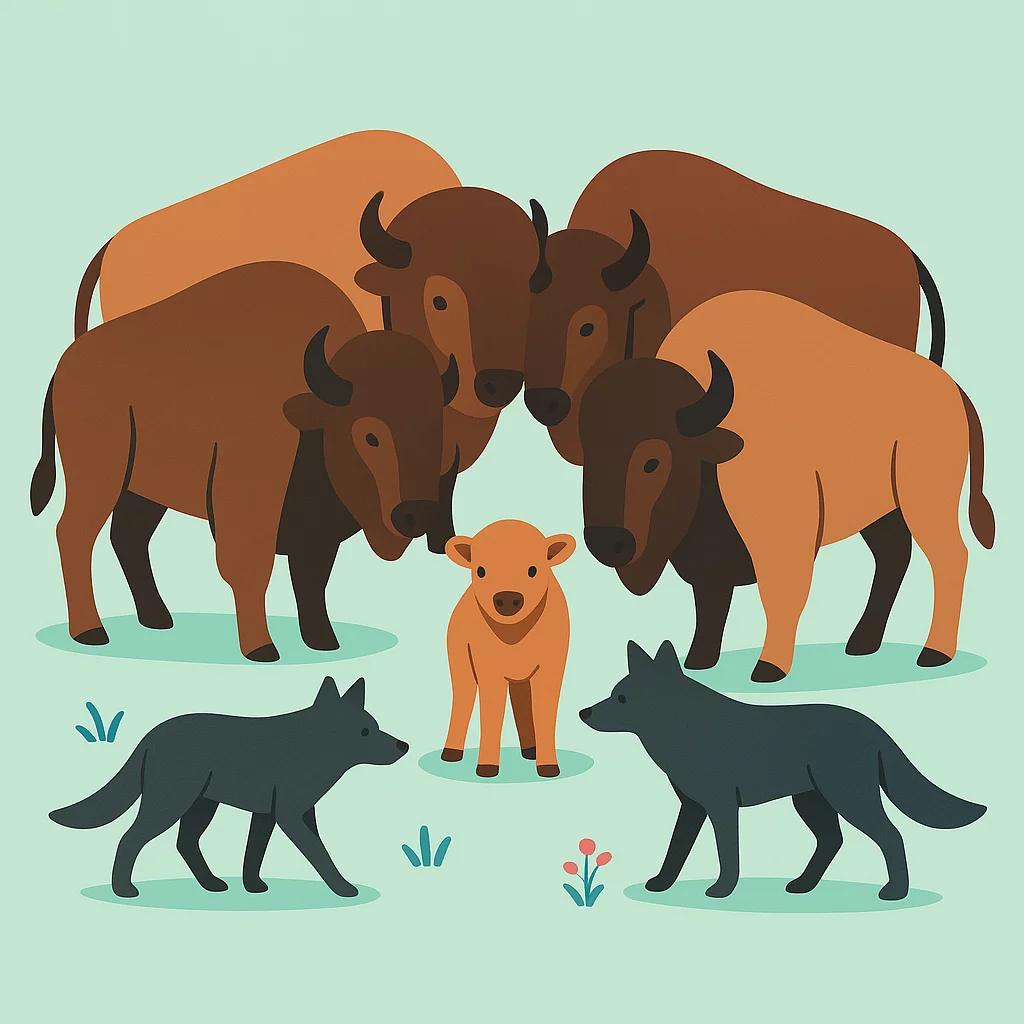
A second attack followed, in which the wolves again seized the calf. This time the entire herd responded — adult bison charged at the predators using their horns and then formed a protective circle around the newborn. The defence proved successful and the wolves eventually retreated.
The study, authored by Robin Wijnands and Tomasz Borowik, notes that although the hunt was unsuccessful, the footage represents rare evidence that wolves do regard bison as potential prey. Until now, data from Białowieża suggested that bison appeared in wolves’ diet only as carrion. Wolf attacks on American bison have been documented in North America, and bear attacks on bison have been reported in Romania, but predation on European bison had not been studied in detail.
The researchers suggest that the small size of the wolf pack may have been insufficient to overcome a herd with such an active defensive strategy. They also note that as the European bison population grows, wolf pack sizes are also increasing, which is likely to lead to more frequent encounters of this kind. If wolves begin hunting bison more regularly, they could act as a natural regulator of bison numbers, potentially reducing crop damage and easing conflict between bison and local communities.
The authors call for future bison reintroduction studies to take greater account of the role of natural predators — not only in terms of mortality, but also the effects on bison behaviour and stress responses.
Advanced: Reports from Poland
- Scientists in Białowieża Prove Wolves Hunt Bison (National Geographic Przyroda)
Polish Learner News
Discover news from Poland to stay informed and practise your skills.
-

Learner News | 23.06.2026
World’s Smelliest Flower to Bloom at Wrocław Botanical Garden
-

Learner News | 16.06.2026
Kasia Lins Dominates Poland’s Fryderyki Awards 2026
-

Learner News | 28.04.2026
Polish Livestream Shatters Record For Cancer Charity