The news in Polish
- naukowiec (m.)
Osoba zajmująca się nauką i prowadząca badania naukowe. ↩︎ - badać
Prowadzić badania, dokładnie sprawdzać lub analizować coś. ↩︎ - grzyb (m.)
Organizm żywy, który nie jest rośliną ani zwierzęciem, np. pieczarka lub borowik. ↩︎ - sygnał (m.)
Informacja lub znak przekazywany między osobami lub obiektami. ↩︎ - elektryczny
Związany z elektrycznością lub działający za pomocą elektryczności. ↩︎ - komunikować
Przekazywać informacje lub porozumiewać się z innymi. ↩︎
Translation
Text comprehension
Question 1: What type of mushrooms did the scientists study?
Question 2: When do the mushrooms send electrical signals to each other?
Vocabulary
| Polish | English |
|---|---|
| naukowiec (m.) | |
| badać | |
| grzyb (m.) | |
| sygnał (m.) | |
| elektryczny | |
| komunikować | |
Interested in learning Polish?
Have a question before you start? Send us a message and we’ll help you figure out the next step – whether you’re just exploring your options or already thinking about lessons.
Contact us about learning
Read the full story
Japanese researchers have observed remarkable behaviour in Laccaria bicolor, a wild mushroom that also grows in Poland. After heavy rainfall, these fungi begin exchanging electrical signals with one another, according to a study published in the journal Fungal Ecology.
The experiments were conducted not in a laboratory but in a mixed forest, making the study unusual. Scientists from Tohoku University in Japan attached electrodes to a cluster of six Laccaria bicolor mushrooms growing beside a path, near an oak and a hornbeam tree. They recorded electrical activity over the final two days of September 2021, during a dry and sunny period with no rain for nearly two weeks.
On the first of October, a typhoon arrived, bringing over three centimetres of rain. Within just two hours of the downpour, the mushrooms became significantly more active electrically. The researchers recorded electrical potential rising to as much as 100 millivolts in some cases.
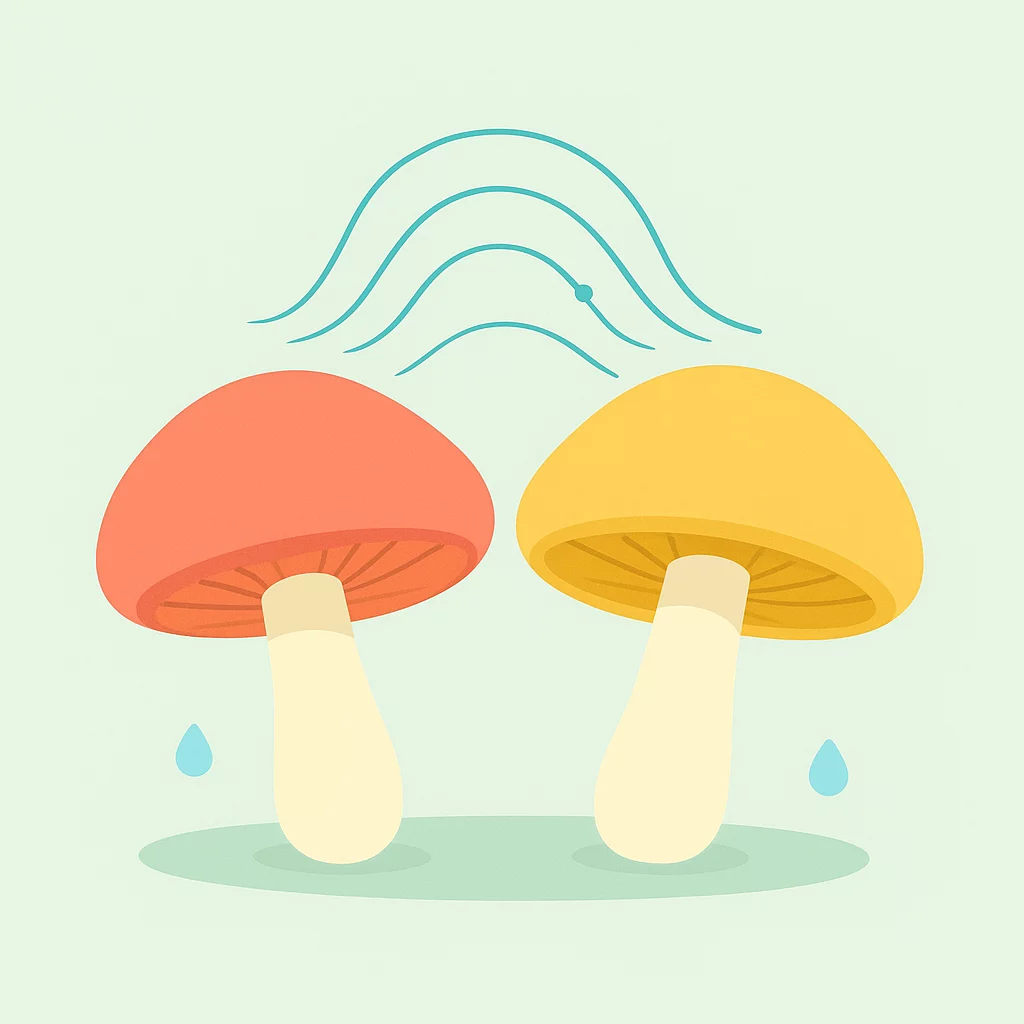
The team also found that changes in the mushrooms’ electrical activity corresponded to changes in temperature and humidity. Notably, mushrooms growing closer together produced stronger electrical signals, suggesting the impulses may serve a communicative function.
This is not the first time scientists have explored the idea that fungi communicate through electricity. In 2022, Andrew Adamatzky from the University of the West of England concluded that electrical activity in fungal networks forms recognisable patterns, which he compared to words in human speech — identifying as many as 50 distinct patterns.
Laccaria bicolor is an edible, gill-bearing mushroom with a long stem and broad cap. It lives in symbiosis with trees, particularly oaks and pines, exchanging water and nutrients for sugars. The fungus is also believed to help trees indirectly consume insects by producing toxins that kill springtails, then sharing the nitrogen extracted from their bodies with the host tree.
Yu Fukasawa, the lead author of the study and a microbiologist, was cautious in his conclusions: “Our results indicate the need for further investigation of the electrical potential of fungi within real ecosystems.”
Advanced: Reports from Poland
- Mushrooms Become Very Talkative After Rain, Using Electricity to Communicate (National Geographic Przyroda)
Polish Learner News
Discover news from Poland to stay informed and practise your skills.
-

Learner News | 07.10.2026
Polish War Loss Returned: Napoleon Painting from Famous Collection
-

Learner News | 07.10.2026
Poland’s 1331 Battle of Płowce: The Truth Behind the Myth
-

Learner News | 07.10.2026
Major Mela Muter Retrospective Opens in Poland and Paris