Learn Romanian online
- Live lessons with native-speaking teachers
- Group and individual lessons planned
- Proven concept from four established schools
- Free Romanian study tool available now
How we’ll teach Romanian
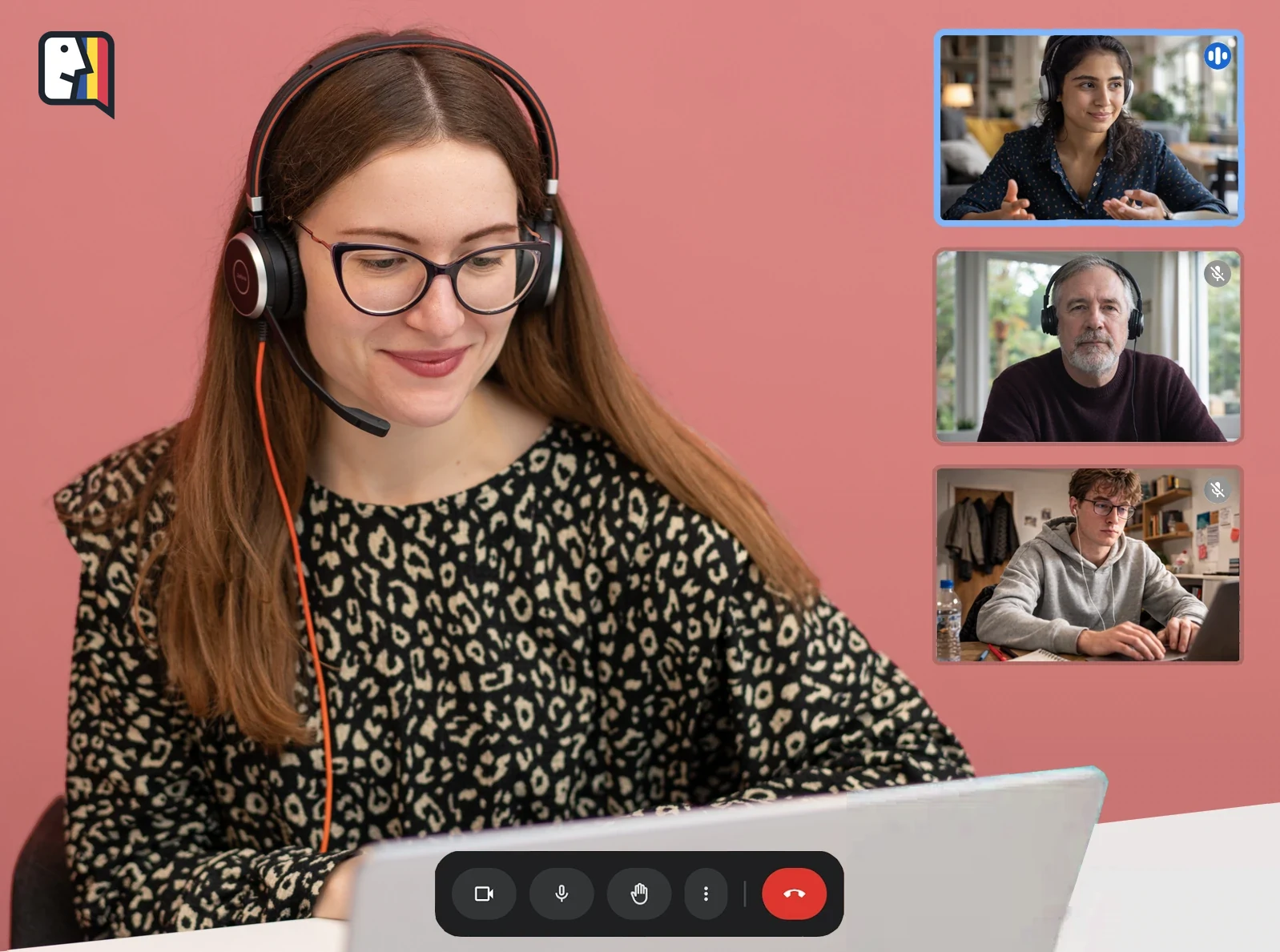
Our Romanian school will use the same proven learning formats as our established language schools.
Group courses
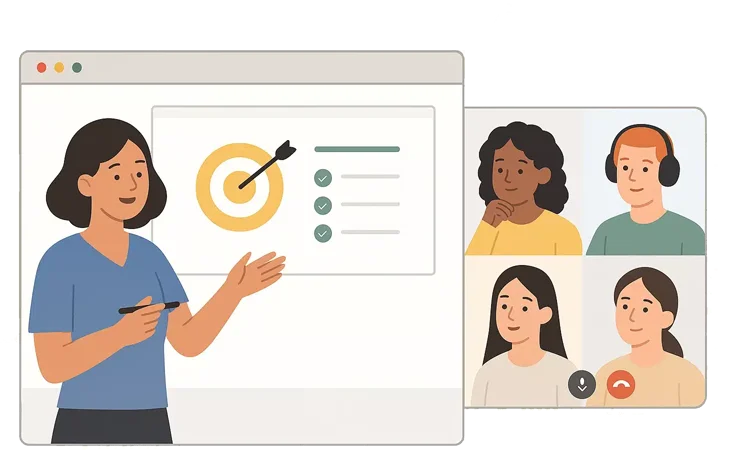
Learn live with a small group at a similar level, following a clear programme and weekly rhythm.

Individual lessons
Learn one-to-one with a teacher, with flexible scheduling and lessons adapted to your goals.
Meet Our Students
Since Let’s Learn was founded in 2009, we’ve helped more than 3,500 learners get to grips with Croatian, Polish, Greek and Ukrainian online.

Stan | Croatian Learner
After 25 years of visits and a repertoire limited to Croatian curse words, this New York journalist finally tackled the language properly.

Julia | Greek Learner
Julia traded scattered holiday phrases for structured Greek lessons, finally connecting properly with her father’s heritage

Michael | Polish Learner
A Hamburg teacher discovers Polish isn’t like Norwegian – but finds the challenge worthwhile for love and cultural connection.

15+
Years teaching
experience
450+
Active
learners
27
Teachers
4
Established language
schools

About Let’s Learn
Let’s Learn is an online language school based in Munich and Zagreb. Since 2009, we’ve helped thousands of people learn Croatian, Greek, Polish and Ukrainian through live lessons, our own materials and practical study tools.
Learn Romanian - start with your first words
Curious how Romanian sounds? Here are a few essential expressions you can pick up right away. Click any word to hear a native speaker say it - and find out whether the language speaks to you.
Everyday basics
Start with a handful of core Romanian words you will hear and use in everyday situations - from simple answers like yes and no through to greetings and polite expressions.
Bună! - Hi!
Salut! - Hello! Hey!
Bună ziua! - Good day!
Bună dimineața! - Good morning!
Bună seara! - Good evening!
Noapte bună! - Good night! (leaving)
La revedere! - Goodbye!
Pa! - Bye!
da - yes
nu - no
Mulțumesc! - Thank you!
Noroc! - Cheers! (not prost = stupid)
Cu plăcere! - You are welcome!
Vă rog. - Please. (formal)
Poftim! - Here you go! / Pardon?
Scuzați-mă! - Excuse me!
Îmi pare rău. - I am sorry.
Desigur. - Of course.
Te rog. - Please. (informal)
Bine. - Good. All right.

Your first conversations in Romanian
Once single words feel comfortable, you can practise typical question-and-answer pairs. These are the foundation of any everyday conversation - you will need them constantly when meeting new people or chatting with locals:
Ce faci? - How are you? (informal; literally: What are you doing?)
Ce faceți? - How are you? (formal)
Mulțumesc, bine. Dar tu? - Thanks, I am well. And you?
Cum te cheamă? - What is your name? (informal)
Cum vă cheamă? - What is your name? (formal)
Mă cheamă Ana. - My name is Ana.
Îmi pare bine! - Nice to meet you!
Vorbiți engleză? - Do you speak English?
Îmi pare rău, nu vorbesc românește. - I am sorry, I do not speak Romanian.
Scuzați, unde este toaleta? - Excuse me, where is the toilet?

Where is Romanian spoken?
Why do people learn Romanian?
Is Romanian hard to learn?
Frequently asked questions
Can I currently book Romanian lessons?
Not yet. We are preparing or assessing a future Romanian school. Register your interest and we will contact you when the first trial lessons or courses become available.
When will Romanian courses begin?
We do not yet have a confirmed launch date. Once our first teaching dates are fixed, people on the interest list will hear from us first.
Will you offer group and individual lessons?
We expect to offer both formats, although the first trial phase may begin with a more limited selection.
Is Romanian a Slavic language?
No. Romanian is a Romance language, descended from the Latin spoken in the Roman province of Dacia, which makes it a cousin of Italian, Spanish, French and Portuguese. The confusion is fair enough: Romania is ringed by Slavic-speaking countries, and roughly 20% of Romanian vocabulary was borrowed from Slavic, mostly via Old Church Slavonic. But the grammar, the numbers, the pronouns and the everyday verbs are all Latin.
Is Romanian hard to learn for English speakers?
Romanian is one of the easier languages for an English speaker. The US Foreign Service Institute places it in Category I, its easiest group, alongside Spanish, French and Italian, at roughly 600 to 750 class hours to reach professional working proficiency. It uses the Latin alphabet, the spelling is near-phonetic, and shared Latin roots mean you will recognise plenty of vocabulary on sight. Noun cases are the genuinely hard part.
How long does it take to learn Romanian?
Reaching A1, where you can introduce yourself and manage simple phrases, is commonly estimated at around 60 to 100 hours of study. Conversational B1 is usually several hundred hours beyond that. The firmest figure available is the Foreign Service Institute’s: about 600 to 750 class hours of full-time instruction for professional working proficiency, which is far above what most casual learners actually need. Consistency beats intensity.
Why does Romanian sound like Russian if it comes from Latin?
Because Romanian’s sounds picked up Slavic habits while its structure stayed Latin. Romanian spent centuries geographically cut off from the other Romance languages and surrounded by Slavic neighbours. It has a “sh” sound written ș, a “ts” sound written ț, and central vowels (ă, â, î) that Italian and English simply lack. The usual description is Italian spoken with a Slavic accent. The vocabulary underneath remains overwhelmingly Latin.
How similar is Romanian to Italian and Spanish?
Romanian is closest to Italian, at an estimated 77% lexical similarity, then French at 75%, Portuguese at 72% and Spanish at 71%. So if you already speak a Romance language, a surprising amount of written Romanian is guessable. Speaking is the harder jump: Romanian kept noun cases and sticks the definite article onto the end of the noun, so “the wolf” is lupul, not el lobo.
Does Romanian have cases, and how many?
Yes, and it is Romanian’s signature feature: it is the only major Romance language that kept noun cases. You will see “five cases” repeated across the web, but that overstates the work. In nouns, nominative and accusative are identical, and genitive and dative are identical, so there are really only three distinct forms, plus a vocative that is quietly fading out of everyday urban speech.
Is Romanian spelled the way it’s pronounced?
Almost entirely. Romanian spelling is essentially phonemic with no silent letters, so once you know the alphabet you can read nearly any word aloud correctly on first sight. The alphabet runs to 31 letters: the 26 Latin ones plus ă, â, î, ș and ț. K, Q, W and Y turn up only in loanwords such as kilogram, quasar, watt and yoga. That is a real advantage over French or English.
Is it worth learning Romanian?
That depends on your reason, but the speaker base is larger than most people assume: roughly 24 million native speakers, and official status in Romania, Moldova and the European Union. Moldovan is the same language under a political label, and Moldova’s parliament formally adopted the name “Romanian” in 2023. For UK-based learners it is unusually practical: the 2021 census counted over 530,000 Romanian-born residents in England alone.
Can you learn Romanian for free?
Yes, and the free tier gets you a long way. Vocabulary trainers, podcasts and Romanian radio and television are all freely available online, and public-domain course materials exist for Romanian. Free resources handle vocabulary and listening well. They are weakest on speaking practice and on correcting your case endings, which is where most self-taught learners stall. Our Romanian vocabulary trainer is free and needs no signup.
Interested in learning Romanian with us?
Leave your details and we will contact you when our first trial lessons or courses become available. There is no commitment, and we will not register you for anything automatically.