
The news in Croatian
Hrvatska je ponovno uvela1 obveznu2 osnovnu vojnu obuku (TVO). Mladići od 18 godina moraju na dvomjesečnu3 obuku, a žene mogu ići dobrovoljno4. Polaznici uče vojničke vještine5, prvu pomoć i rade u timu. Tijekom obuke dobivaju plaću, uniformu i smještaj, a nakon toga mogu ostati u vojsci ili ići u pričuvu6.
- uvesti
početi primjenjivati nešto novo ili ponovno, početi koristiti neki zakon, pravilo ili običaj ↩︎ - obvezan
koji se mora ispuniti ili napraviti, nije dobrovoljan nego propisan kao dužnost ↩︎ - dvomjesečan
koji traje dva mjeseca ↩︎ - dobrovoljan
iz vlastite želje, bez prisile, jer to netko sam želi ↩︎ - vještina (f.)
ono što netko zna dobro raditi zahvaljujući znanju i vježbi ↩︎ - pričuva (f.)
skupina vojnika koja nije stalno u vojsci, ali može biti pozvana u službu kada zatreba ↩︎
Translation
Text comprehension
Question 1: How long does the basic military training last for young men in Croatia?
Question 2: Name two things that participants receive during the training.
Vocabulary
| Croatian | English |
|---|---|
| uvesti | |
| obvezan | |
| dvomjesečan | |
| dobrovoljan | |
| vještina (f.) | |
| pričuva (f.) | |
Interested in learning Croatian?
Have a question before you start? Send us a message and we’ll help you figure out the next step – whether you’re just exploring your options or already thinking about lessons.
Contact us about learning
Read the full story
Croatia has restarted its system of mandatory basic military training after almost two decades. On Monday, a first group of about 800 recruits – both young men and women – entered three Croatian army bases in Knin, Slunj and Požega to begin a two‑month training programme.
The training, officially called Temeljno vojno osposobljavanje (TVO), follows the end of compulsory national service in 2007–2008. According to the Croatian Ministry of Defence, up to 4000 conscripts will be called into the armed forces each year, divided into five groups. This marks a significant change in Croatia’s defence policy and affects young adults across the country.
Under the new rules, men who turn 18 are entered into the military register and can be called to TVO in the year they reach that age. In 2026, this includes men born in 2007. Some older men, up to the age of 30, may also be called if they meet certain legal criteria. Women are not obliged to take part, but are free to join voluntarily. Among the 800 participants in the first group, media report that 446 are volunteers, including more than 80 women, and around 350 are serving under obligation.
The Ministry of Defence states that only a small proportion of those called up have used the right to conscientious objection. Those who declare that they cannot perform military service for moral or religious reasons will not attend TVO. Instead, they will complete a period of civilian service, lasting three to four months, in non‑military institutions.
The two‑month TVO programme combines theory and practice. Recruits will learn basic military skills such as handling personal weapons, using modern equipment including drones, and practising self‑defence. The training also includes first aid and lessons on key military operations from Croatia’s Homeland War in the 1990s. Instructors from the Croatian Armed Forces, with long experience in voluntary military training, aim to develop teamwork, discipline and a sense of responsibility among the recruits.
The first day in the barracks follows a clear routine. New arrivals are registered, then go to the stores to collect their uniforms and equipment. Reports describe the basic kit as including army boots, trousers, shirts and T‑shirts, usually in two sets, as well as two jackets and sports clothes such as tracksuits, trainers and shorts. After receiving their kit, recruits organise their lockers, change into uniform and start adapting to the daily schedule of military life.
The head of the General Staff, General Tihomir Kundid, told Croatian media that the armed forces will introduce recruits step by step to the military environment. He explained that they are coming directly from civilian life, so the first days are planned to limit stress and allow a gradual adjustment to military discipline and routines. According to Kundid, the young people are highly motivated and, in his view, ready to reach the standards set for them during the eight weeks of training.
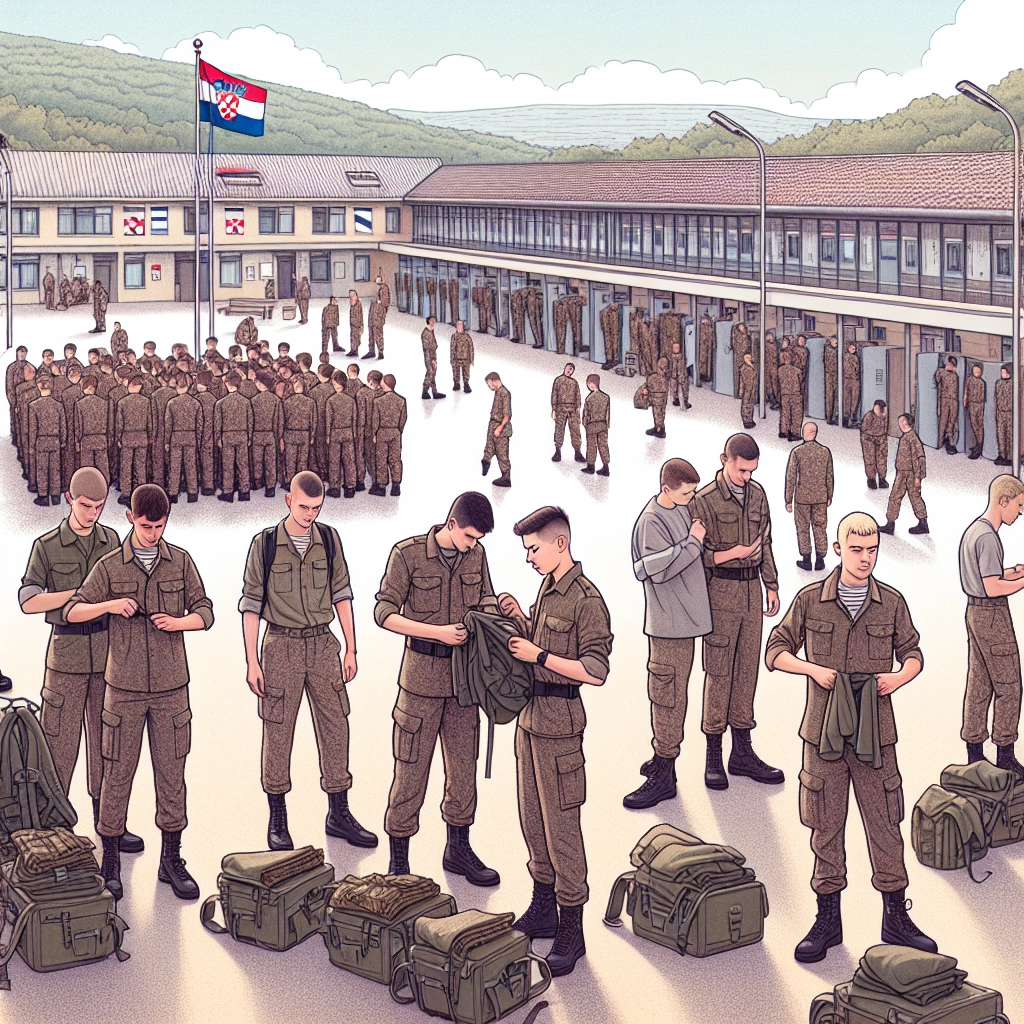
Croatia’s Deputy Prime Minister and Defence Minister Ivan Anušić visited the Slunj training area to welcome around 200 of the first recruits. He described the start of TVO as an important moment for Croatia’s defence system and said the project has been in preparation for about a year and a half. Anušić highlighted what he sees as a strong response rate and thanked both the recruits and the armed forces for their organisation. His advice to participants was to listen carefully to their officers and instructors in order to gain as much knowledge and experience as possible.
Some recruits also spoke to journalists about their expectations. One young man said he had been preparing himself for TVO since the previous autumn and felt ready to begin. Another recruit, who lives in Germany but has Croatian roots, said he came to Croatia voluntarily to serve because he wanted to join the Croatian army and saw the training as a positive experience that could improve his discipline and work habits.
During TVO, recruits receive a monthly payment of around 1100 euros net, though the exact amount depends on local tax rules. They also have travel costs and leave paid by the state. For those already employed, the period of training counts as work: their employment rights are suspended rather than ended, they continue to receive income at about the same level and, by law, cannot be dismissed because of their military service. In addition, they gain two months of work experience in the national pension and employment records.
Financing the reintroduction of basic military training is a notable item in the defence budget. The Ministry of Defence estimates the annual cost of TVO at around 23.7 million euros. Supporters in government and the military argue that this investment strengthens national defence and gives young people useful skills, including discipline, teamwork and familiarity with emergency procedures. They also emphasise that completing TVO gives participants priority, under equal conditions, when applying for permanent jobs in state institutions and in local and regional government offices.
When the two‑month training ends, recruits have different paths. Those who wish to continue can apply for professional military service and later develop careers in the Croatian Armed Forces. Others who do not stay in the army will be placed into the reserve forces as trained reservists. Supporters of the programme present this as a way to increase the number of citizens with basic military knowledge after a long period in which, according to General Kundid, about 300,000 potential recruits received no such training.
Public debate in Croatia includes a range of opinions about the return of compulsory training, from those who see it as necessary for security and civic responsibility to those who are concerned about costs, personal freedom and the impact on young people’s plans for work or study. The current reports from Croatian media mainly focus on the formal launch of the programme, the organisation of training, and the first reactions of recruits and military leaders, rather than on broader political criticism or support.
For observers outside Croatia, the restart of TVO illustrates how a European Union and NATO member state is adapting its defence policies in a changing security environment. It also shows how one small country is trying to connect military service with education, employment benefits and civic duties for its younger generations.
Info: ‘Croatian Learner News’ is a service from ‘Let’s Learn Croatian’, a language school dedicated to teaching Croatian through various online courses, where you can choose the Croatian language course that best suits your needs.
Advanced: Reports from Croatia
- Big Photo Report: First Recruits Begin Basic Military Training, Welcomed with Special Ceremony in Slunj (Jutarnji list)
- 800 Conscripts Enter Barracks Today as Military Service Returns After 20 Years (Index.hr)
- VIDEO Anušić Welcomes First Conscripts Under Mandatory Service: ‘I Only Ask That You Listen’ (Večernji list)
- Mandatory Military Training Begins: 800 Male and Female Conscripts Report to Barracks – “I’ve Been Ready Since October” (Dnevnik.hr)
- These Croatian Conscripts Just Started Military Service – Here’s What They Got: “They’re Absolutely Ready!” (Net.hr)
Croatian Learner News
Discover news from Croatia to stay informed and practise your skills.
-

Learner News | 28.04.2026
Dubrovnik Hosts Major Three Seas Initiative Summit
-

Learner News | 26.04.2026
Sisak protest targets planned chicken megafarms
-
Learner News | 21.04.2026
Croatia boosts funding to tackle demographic decline