The news in Greek
- εκατομμύριο (n.)
Ο αριθμός 1.000.000, πολύ μεγάλος αριθμός. ↩︎ - έκλειψη (f.)
Το φαινόμενο όταν ένα ουράνιο σώμα κρύβεται από άλλο, π.χ. ο ήλιος από τη σελήνη. ↩︎ - πλήρης
Αυτό που είναι ολοκληρωτικό, τέλειο, χωρίς να λείπει τίποτα. ↩︎ - μερικός
Αυτό που αφορά ένα μέρος μόνο και όχι το σύνολο. ↩︎ - χρησιμοποιώ
Κάνω χρήση κάποιου αντικειμένου ή εργαλείου για κάποιο σκοπό. ↩︎ - επικίνδυνος
Αυτό που μπορεί να προκαλέσει κίνδυνο ή βλάβη. ↩︎
Translation
Text comprehension
Question 1: Which country will experience a total solar eclipse for the first time since 1905?
Question 2: Which part of Greece will see a partial solar eclipse?
Vocabulary
| Greek | English |
|---|---|
| εκατομμύριο (n.) | |
| έκλειψη (f.) | |
| πλήρης | |
| μερικός | |
| χρησιμοποιώ | |
| επικίνδυνος | |
Practise Greek for free
Use our interactive study tool to improve your Greek with vocabulary quizzes, grammar exercises, and progress tracking. Pick a topic, start a quiz, and see how your skills grow over time.
Try the study tool
Read the full story
On the afternoon of Wednesday 12 August, millions of people across Europe will witness one of the most significant astronomical events of the year: a total solar eclipse. The Moon will pass in front of the Sun, casting its shadow across a large portion of the northern hemisphere.
The narrow path of totality will cross Greenland, Iceland, Spain, and a small part of north-eastern Portugal. For Spain, it is a historic occasion — according to the European Space Agency, it is the first total solar eclipse visible from mainland Spain since 1905. Cities including La Coruña, Oviedo, Bilbao, Zaragoza, and Valencia all fall within the totality zone. In León, NASA calculates that the total phase will begin at around 20:28 local time and last approximately two minutes. Across much of the rest of western and central Europe, the eclipse will be partial but still striking — the Royal Observatory Greenwich estimates that 90–96% of the Sun will be covered in Britain and Ireland.
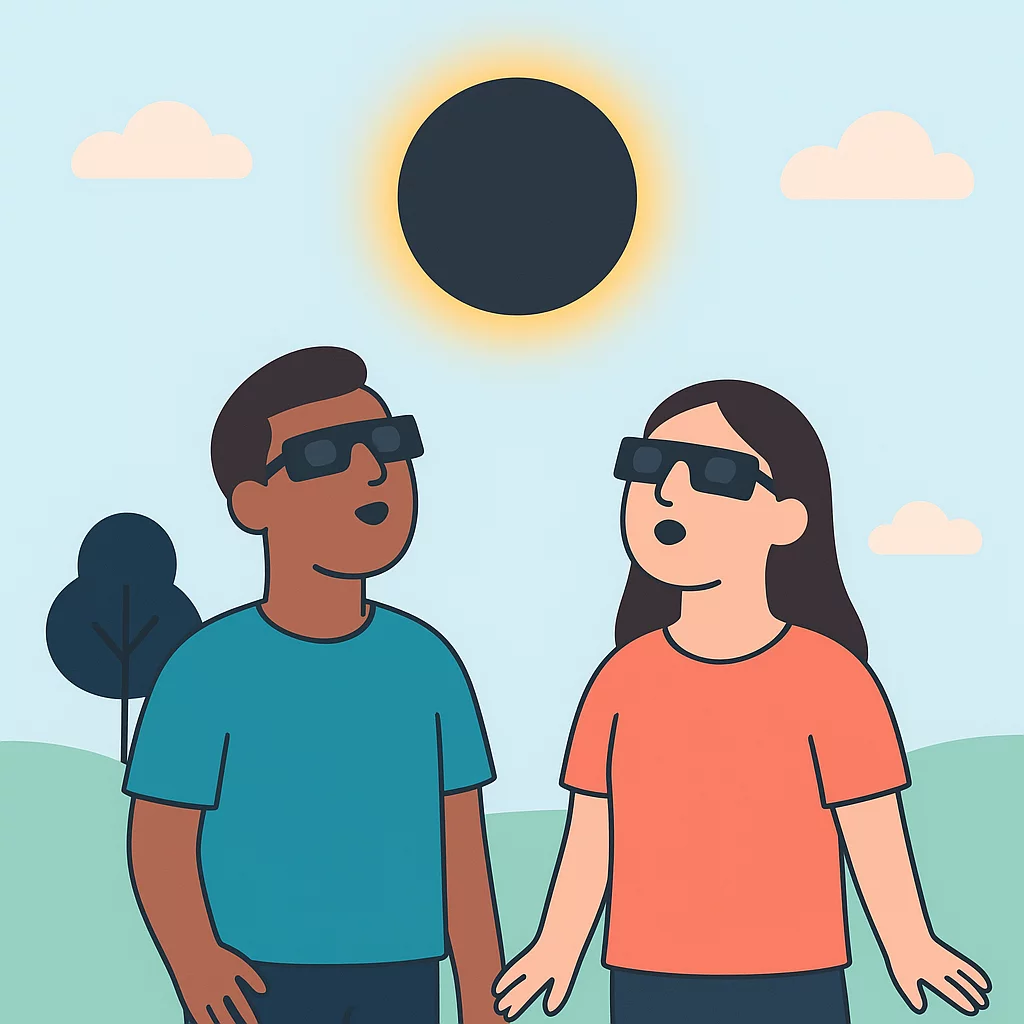
Greece lies at the very edge of the observable zone. No total eclipse will be visible from anywhere in the country, and only the north-western corner will catch even a partial eclipse, shortly before sunset. Corfu offers the best vantage point in Greece, where the Moon will cover just 2.34% of the solar disc, beginning at around 20:33 and peaking at around 20:37. Athens will see nothing at all, as the Sun sets there at 20:22 — before the eclipse becomes visible from the western edge of Greece. Observers in the north-west who do attempt to watch must have a completely unobstructed view of the western horizon, as even a hill, building, or tree could block the brief event.
Alongside the main spectacle, scientists are hoping to study a strange and still unexplained phenomenon known as shadow bands — faint, rippling dark and light stripes that appear on pale surfaces just before and after totality. David Turnshek, a professor of physics and astronomy at the University of Pittsburgh and director of the Allegheny Observatory, has been investigating the phenomenon since he first observed it as a teenager in 1970. After securing NASA funding, he travelled to Tennessee with a team of students during the 2017 eclipse. Their results suggested that the prevailing theory — which attributes shadow bands to atmospheric turbulence — may not be the only explanation, as sensors recorded a consistent signal of 4.5 Hz both at ground level and at an altitude of 25 kilometres above most of the atmosphere. Turnshek is now travelling to León, Spain, for this eclipse, and plans to bring an electronic detector with him, though a full repeat of the high-altitude balloon experiment will not be possible.
Experts are also issuing strong safety warnings. Looking directly at the Sun — even for a few seconds — can cause serious, sometimes permanent damage to the retina, a condition known as eclipse blindness. The retina has no pain receptors, meaning injury can occur without any sensation at the time, and symptoms may not appear immediately. Ordinary sunglasses offer no protection. Specialists recommend only certified solar viewing glasses that meet the international standard ISO 12312-2, or indirect projection methods such as a pinhole projector. The fact that the Sun will be low on the horizon during this eclipse may create a false sense of safety, but experts stress that a low or partially covered Sun is no less dangerous to the eye.
Advanced: Reports from Greece
- Total Solar Eclipse: Where Will It Be Visible (News247 Epistimi)
- Shadow Bands: The Strange Phenomenon That Accompanies Total Eclipses (ERT Epistimi)
- Solar Eclipse: Where and When Will It Be Visible in Greece (Kathimerini Science)
- Painless and Untreatable: The Silent Danger of the Solar Eclipse That Can Damage Eyes in Seconds (Iefimerida Ygeia)
Greek Learner News
Discover news from Greece to stay informed and practise your skills.
-

Learner News | 06.10.2026
Mount Olympus Joins UNESCO World Heritage List as Mixed Site
-

Learner News | 06.10.2026
Athens Museum Wins European Art Museum Award 2026
-

Learner News | 22.09.2026
Greece Wins Double EU Recognition for Quantum Communication Projects