The table where nobody spoke his language
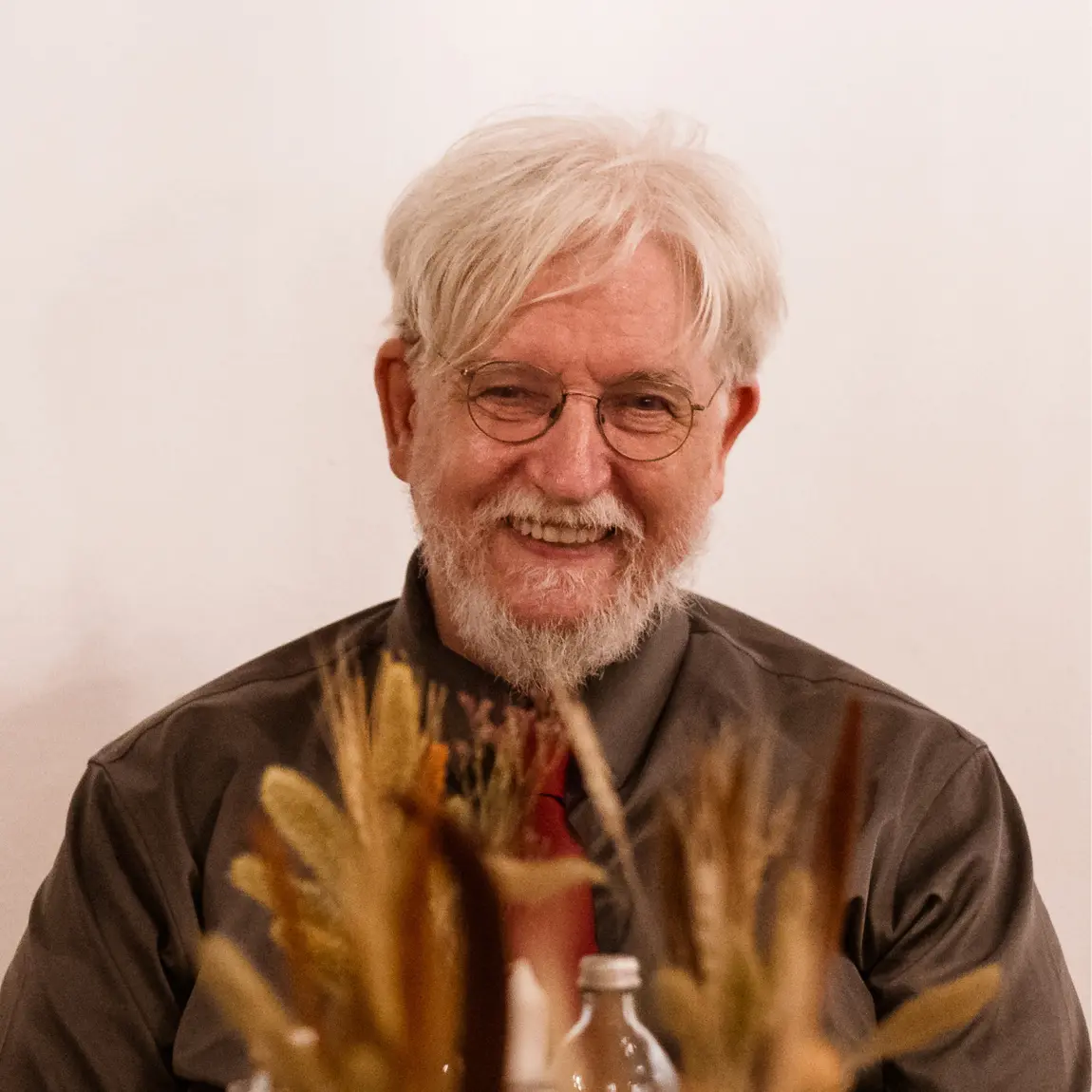
Manfred is a man of deep roots. Born in Vienna, he has lived in the same apartment for fifty years and has no plans to leave. For the working years of his life he looked after IT systems – not because he had studied computer science, but because he stumbled into it in the mid-1980s and learned everything by doing. That same apartment has been shared with his sister for much of that time, and he watched his niece grow up there alongside them, a borrowed child, as he affectionately calls her.
“People would ask how I was, and I simply couldn’t reply.”
When he retired, his sister’s long-standing habit of travelling to Crete became something he could share. She had been going for thirty years, built up a wide circle of Greek friends, and learned the language entirely by ear – fluently enough, in her own dialect way, to hold her own in any conversation. Manfred had joined her on the island three times since retiring. Each visit, he sat at tables where lively exchanges flowed around him and found he could contribute nothing. Someone would ask how he was and he had no answer. That specific discomfort – not an abstract love of languages, but the plain wish to respond when someone speaks to you – was what finally pushed him towards Greek.
A script unlike anything he had encountered before
Greek does not ease you in. Manfred had dealt with a non-Latin alphabet before – he had studied Russian for three years at school and worked his way around the Cyrillic script – but Greek, he says, is another matter entirely. The alphabet alone presents its own set of puzzles. There are, he notes with dry amusement, five different ways to write the sound of the letter I. Why anyone needs five Is, he is not entirely sure. But there they are, and learning to read them was his first real hurdle.
After the script came pronunciation, and after pronunciation, grammar. The Greek system of cases, genders and agreements felt genuinely demanding: knowing which article belongs with which noun, which ending signals which case, which combinations fit and which do not. He is realistic about all of this. Language learning, he says, has no finish line – he has spoken German his whole life and still could not claim to have fully absorbed its reformed spelling rules. Greek will be the same: a thing you keep learning, layer by layer, for as long as you bother to try.
A life made of images and accumulated stories
Retirement has given Manfred more time for the things he has always been drawn to. He is a photographer, though not in any conventional sense. His real interest lies in what he does with the images afterwards: he makes books. Not simple photo albums, but proper assembled volumes that mix photographs, drawings, personal writing and family history. He has produced one tracing his ancestors – part memoir, part archive, part illustrated record of where he came from. It is the kind of project that takes patience and a feel for arrangement, and he approaches it with the same quiet care he once brought to setting up IT systems.
“I slid into IT sideways – I’d never actually studied it. By 1985 it was entirely learning by doing, a hundred per cent.”
Music is another constant. He listens in particular to Greek singer-songwriters from the 1970s and 80s, and this habit has quietly become part of his language learning too. What was once a stream of undifferentiated sound has begun to separate into recognisable parts. He catches a word, then another, then a third. Slowly, the shape of a song emerges from what had seemed incomprehensible. These small moments of recognition are, he says, their own kind of breakthrough.
One lesson at a time, in exactly the right format
Before finding Let’s Learn, Manfred had spent time with Duolingo and a handful of similar apps. He found them useful for one specific purpose: getting familiar with the Greek alphabet and picking up a basic stock of vocabulary. For anything beyond that, they fell short. Sentence construction, verb forms, the logic of grammar – none of it featured. He knew he needed structured lessons with a teacher, but he also knew something about himself: he is not, in his words, a born performer. Group sessions were never going to suit him. Speaking in front of others, even a small group, would have got in the way of actually learning.
Individual lessons with his teacher Maria turned out to be the right arrangement. She has adapted her approach to him over time, working out that vocabulary sticks best through repeated questioning rather than written drills – a cycle of forgetting, re-hearing and eventually retaining that suits someone who is, by his own cheerful admission, close to seventy and not finding memorisation quite as natural as he once might have. The flexibility of the format helps too: he books lessons according to when both he and Maria are free, sometimes in blocks of three hours, occasionally four.
Free trial lesson
Curious about live learning? Join a free trial lesson and see what it’s like to learn with us. No commitment, no pressure – just a friendly session to find out if it’s the right fit for you.
Reserve your spot
Each lesson carries its own small victory
Manfred does not believe in breakthrough moments when it comes to language learning. There is no single point at which everything clicks, no morning you wake up and simply know Greek. What there is instead is a gradual accumulation of small things going right: recognising which case to reach for, getting the gender right alongside it, seeing these agreements fall into place with increasing regularity. If a lesson goes well, he says, then that lesson is its own breakthrough. And the lessons tend to go well.
“I enjoy going to the lessons. I never think: oh no, Greek tomorrow.”
He is clear about why that is. Maria, he says, is an excellent teacher – patient, attentive, good at reading where he is on a given day and at finding ways to keep things moving. Without that, he suspects he would have stopped after five sessions and concluded that it was never going to work. Instead he keeps going back. The next trip to Crete may still be some way off, but the Greek songwriter he listened to this morning gave up a few more words than he did a few months ago. That, for now, is more than enough reason to continue.
Teacher and student stories
Discover inspiring language journeys and see how others are learning and teaching Greek.
Vanessa | Student
Growing up half-Greek in Hamburg, Vanessa always felt the pull of her heritage. Now she’s closing the gap, one lesson at a time.
Susanne | Student
After years of trying different schools and methods, Susanne found that classic vocabulary drills and homework deadlines work best.
Antonia | Student
From understanding nothing in Greek supplier meetings to building genuine connections through language learning.