
The news in Greek
- συμφωνία (f.)
γραπτή ή προφορική δέσμευση ανάμεσα σε δύο ή περισσότερες πλευρές για κάτι που θα κάνουν ↩︎ - άμυνα (f.)
ενέργειες και μέτρα για να προστατεύεται μια χώρα ή ένας άνθρωπος από επίθεση ↩︎ - εκπαίδευση (f.)
η οργανωμένη μάθηση σε σχολεία, πανεπιστήμια κτλ. ↩︎ - έρευνα (f.)
συστηματική προσπάθεια για να βρούμε νέες γνώσεις ή πληροφορίες ↩︎ - ψηφιακός
που λειτουργεί με αριθμούς στον υπολογιστή ή στο διαδίκτυο, όχι με αναλογικό τρόπο ↩︎ - τεχνολογία (f.)
σύνολο γνώσεων και μεθόδων που χρησιμοποιούμε για να φτιάχνουμε μηχανές, συσκευές και συστήματα ↩︎
Translation
Text comprehension
Question 1: In which city did Greece and France sign the new agreements?
Question 2: Besides defence, name one other area where Greece and France will work together.
Vocabulary
| Greek | English |
|---|---|
| συμφωνία (f.) | |
| άμυνα (f.) | |
| εκπαίδευση (f.) | |
| έρευνα (f.) | |
| ψηφιακός | |
| τεχνολογία (f.) | |
Already know some Greek?
Take our free placement test and find your current level in just a few minutes. It’s fun, fast, and helps you understand exactly where you are – and what the next step in your learning journey might be.

Read the full story
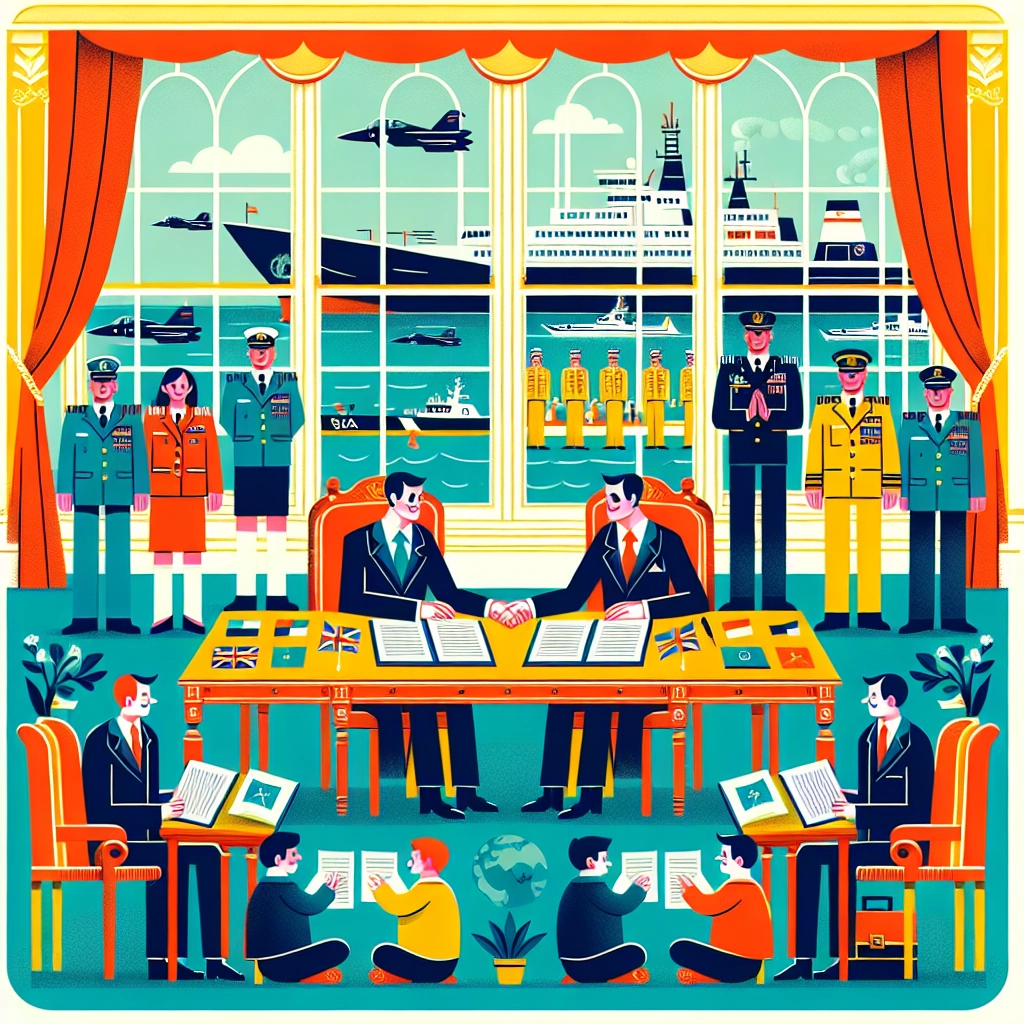
The leaders of Greece and France have signed a package of nine new agreements in Athens, deepening their long‑standing political and military cooperation and setting out plans for closer work in areas such as education, research, nuclear technology and digital innovation.
The signing ceremony took place at Maximos Mansion, the official seat of the Greek Prime Minister. Kyriakos Mitsotakis and Emmanuel Macron renewed the countries’ Enhanced Comprehensive Strategic Partnership, first agreed in 2021, and described the moment as an important step in bilateral relations at a time of increased global instability.
Several detailed agreements were concluded by the responsible ministers. These included the formal renewal of the defence and security partnership between Greece and France, a roadmap for closer cooperation between the two foreign ministries, and a new framework for research and innovation in defence and military technologies. Another agreement sets out continued support for MICA IR/RF missiles, used by the Greek Air Force, through a framework deal and an initial implementation contract with French company MBDA from 2026.
Beyond defence, the two governments agreed a Joint Declaration of Intent on vocational education, training and lifelong learning, as well as an Action Plan for higher education and scientific research cooperation covering the years 2026–2030. They also signed a Joint Declaration of Intent on nuclear technology cooperation and a convention to create an intergovernmental organisation for digital ocean systems and IT services, pointing to future collaboration on advanced technologies and marine data.
Both leaders highlighted the importance of the mutual assistance clause within their strategic partnership, which states that each country will support the other if its sovereignty is threatened. Mitsotakis called this clause the “crowning” element of the new package, arguing that it strengthens the deterrent capacity of Greece and helps protect both Greek and European Union external borders.
Macron, referring to tensions in the Eastern Mediterranean in recent years, said that France would stand by Greece if its security or sovereignty were at risk. He pointed to French actions during the summer 2020 standoff with Turkey and during recent tensions affecting Cyprus as evidence that the commitment is not only symbolic. According to the French president, this is, in his view, the “real definition of friendship”.
The two leaders underlined that their cooperation also fits into a broader discussion about European strategic autonomy. They argued that the partnership supports a stronger European pillar within NATO, rather than weakening the alliance. Macron stressed that European countries are increasingly conducting joint missions in regions such as the Baltic, the Eastern Mediterranean and the Strait of Hormuz, sometimes outside direct NATO structures, and that deeper Franco‑Greek cooperation contributes to this trend.
A visible symbol of the military aspect of the relationship came earlier in the day, when Mitsotakis and Macron visited the newly delivered Greek frigate “Kimon” in the port of Piraeus. The vessel is one of four Belharra‑class frigates ordered from France’s Naval Group. The leaders toured the operations centre and the bridge, accompanied by the defence ministers and senior naval officers of both countries. Aircraft from the French‑built Rafale fleet performed a fly‑past during the official welcome, highlighting the recent purchase by Greece of 24 Rafale fighter jets.
Greek officials presented these acquisitions, together with the missile support agreement, as a major upgrade of the Hellenic Navy and Air Force. They argue that the fact both navies operate the same type of frigate improves interoperability in combined operations. Supporters of the deals say this reinforces security not only for Greece but for the wider European region, particularly after Russia’s full‑scale invasion of Ukraine.
The visit and the signing of the agreements were followed by a public discussion at the Roman Agora in Athens, where Mitsotakis and Macron spoke at length about the future of Europe. The conversation, moderated by a Greek newspaper editor, covered European defence, economic competitiveness, relations with the United States, China and the Middle East, energy security and the role of the Franco‑Greek partnership within these debates.
Macron described the current period as potentially “Europe’s moment”, but also as one of “global disorder”. He argued that the leaders of the United States, Russia and China are, in different ways, pursuing policies that do not always align with European interests. In his view, this means the European Union needs more confidence and unity, as well as stronger tools in areas such as defence, industry, agriculture and finance.
Both leaders agreed that the war in Ukraine has underlined the need for Europe to take greater responsibility for its own security. Macron defended the EU’s response to the invasion, pointing to multiple rounds of sanctions against Russia and extensive financial and military support for Kyiv. He argued that, despite many early predictions, Ukraine has resisted and even regained territory, partly due to European assistance.
On the economic front, Macron and Mitsotakis discussed concerns about Europe’s competitiveness compared with other major powers. They noted that both the United States and China actively support their domestic industries through regulations, subsidies and trade barriers. Macron said the EU has at times been “naive” in accepting this situation and called for “smarter regulation” in Europe that protects producers but does not suffocate innovation.
Mitsotakis argued that Chinese competition represents a serious challenge for European manufacturing and suggested changing merger rules and encouraging more cross‑border investments inside the EU to create firms that can operate at larger scale. As an example, he mentioned the participation of Euronext in the Athens Stock Exchange as a positive development for the Greek market. He also expressed hope that European partners, including France and Germany, can cooperate on developing a sixth‑generation fighter aircraft in future.
The discussion also touched on energy policy. Mitsotakis said that guaranteeing affordable and sufficient energy is a key challenge, and that Europe may need to consider a stronger role for nuclear power, combined with renewable sources, taking inspiration from the French model. This connects directly with the new nuclear technology cooperation agreement signed earlier in the day.
Regarding relations with the United States, Macron and Mitsotakis acknowledged that recent American administrations, regardless of political party, have put a strong emphasis on national interests and “America First” policies. Both leaders suggested that while the transatlantic partnership remains important, Europe must develop more autonomous capabilities so that it is less dependent on decisions made in Washington.
At the same time, Mitsotakis pointed to opportunities for Europe to build stronger ties with other partners such as India, Gulf states, Canada, Australia and Southeast Asian democracies. He presented this as part of a move towards a more multipolar international order, in which the EU and countries like Greece can diversify their alliances.
Overall, the visit underlined how Athens and Paris see their relationship as both a bilateral alliance and a model within the European Union. For supporters, the new agreements confirm that the historic slogan “Greece–France alliance” still has strategic relevance, combining security cooperation with education, technological and economic links. Critics of increased defence spending, who are present in broader European debates though not highlighted in the official events, might raise questions about costs or regional tensions. However, the official positions presented in Athens focused mainly on the need for European partners to act together in a period of rapid geopolitical change.
Info: ‘Greek Learner News’ is a service from ‘Let’s Learn Greek’, a language school dedicated to teaching Greek, where each Greek course is offered online to support learners at different levels.
Advanced: Reports from Greece
Greek Learner News
Discover news from Greece to stay informed and practise your skills.
-
Learner News | 22.04.2026
Greece Sends Humanitarian Aid Mission to Lebanon
-
Learner News | 20.04.2026
Mass Dog Poisoning Shocks Halkidiki Village
-
Learner News | 20.04.2026
Loose cow disrupts traffic on Thessaloniki highway