
The news in Croatian
Hrvatska želi kupiti nova oružja1 iz Francuske i Njemačke. Premijer Plenković putuje u Pariz i Berlin s delegacijom2. Tamo će razgovarati o tenkovima, haubicama3 i drugim vojnim temama. Osim toga, žele jače gospodarske4 odnose i suradnju5 između država i kompanija iz energetike6, turizma i tehnologije.
- oružje (n.)
sredstvo koje se koristi za napad ili obranu, npr. pištolj, puška, bomba ↩︎ - delegacija (f.)
skupina ljudi koja službeno predstavlja neku državu, organizaciju ili ustanovu ↩︎ - haubica (f.)
vrsta teškog topničkog oružja koje ispaljuje granate na veću udaljenost ↩︎ - gospodarski
koji se odnosi na gospodarstvo, na proizvodnju, trgovinu i novac u nekoj državi ↩︎ - suradnja (f.)
zajednički rad dviju ili više osoba ili skupina radi postizanja cilja ↩︎ - energetika (f.)
područje koje se bavi proizvodnjom, prijenosom i potrošnjom energije ↩︎
Translation
Text comprehension
Question 1: Why is Prime Minister Plenković traveling to Paris and Berlin with a delegation?
Question 2: Besides weapons, what other kinds of cooperation does Croatia want with France and Germany?
Vocabulary
| Croatian | English |
|---|---|
| oružje (n.) | |
| delegacija (f.) | |
| haubica (f.) | |
| gospodarski | |
| suradnja (f.) | |
| energetika (f.) | |
Free 6-week email course
Just starting with Croatian? Get one easy lesson per week plus a short exercise to help things stick. Sign up now to begin your Croatian journey!

Read the full story
Croatia is preparing to sign major defence procurement contracts with France and Germany, while at the same time trying to deepen wider political and economic ties with both countries.
Prime Minister Andrej Plenković will travel early next week to Paris and Berlin with a large political and business delegation. During the visit, Croatia plans to formalise the purchase of 18 French Caesar MK2 self-propelled howitzers and 44 German Leopard 2A8 main battle tanks.
The contracts will be signed by Croatian Defence Minister Ivan Anušić and his French and German counterparts. According to government sources, the purchases will be financed through the European Union’s SAFE financial instrument, which is designed to support defence capability across the EU.
German and French media and officials have highlighted that these deals come at a time of intensified modernisation of European armed forces. France and Germany are currently among the EU leaders in defence investment and in the development of new military technologies. For Croatia, a relatively small member state, this is presented as a significant step in updating its armed forces, which are still partly based on equipment inherited from the 1990s war of independence.
The Leopard 2A8 tanks are described in Croatian reports as coming in a “full package”, including spare parts, simulators and logistical support. The estimated value is around €1.3 billion, with part of the cost to be reduced because Croatia has previously supplied weapons to Ukraine, a contribution that is counted within EU support schemes. The Caesar howitzers are expected to cost about €320 million.
Alongside the military deals, Croatia aims to reinforce its wider strategic partnerships. In Paris, an Action Plan for Strategic Partnership will be signed, building on a broader agreement concluded in 2021 between President Emmanuel Macron and Prime Minister Plenković. That earlier agreement included French backing for Croatia’s successful entry into the Schengen Area and the eurozone, and support for its still ongoing bid to join the OECD.
In both Paris and Berlin, the agenda goes beyond weapons. Talks are expected to cover Ukraine and current peace efforts to end Russia’s invasion. Croatian government sources argue that Croatia can contribute its experience from the conflicts of the 1990s. Other topics include the situation in the Western Balkans, with special attention to Bosnia and Herzegovina, as well as transatlantic relations, the next long-term EU budget (Multiannual Financial Framework 2028–2034), energy policy, security and defence cooperation.
The programme also contains symbolic and academic elements. The visit to France will begin at the Hôtel des Invalides in Paris, where there is a memorial plaque to Croatian regiments that fought in the army of Napoleon Bonaparte. After laying a wreath, Plenković is scheduled to give a lecture at the French Institute of International Relations (IFRI) before a meeting at the Élysée Palace with President Macron. In Germany, the Prime Minister will hold a lecture at the Konrad Adenauer Foundation before talks with German Chancellor Friedrich Merz.
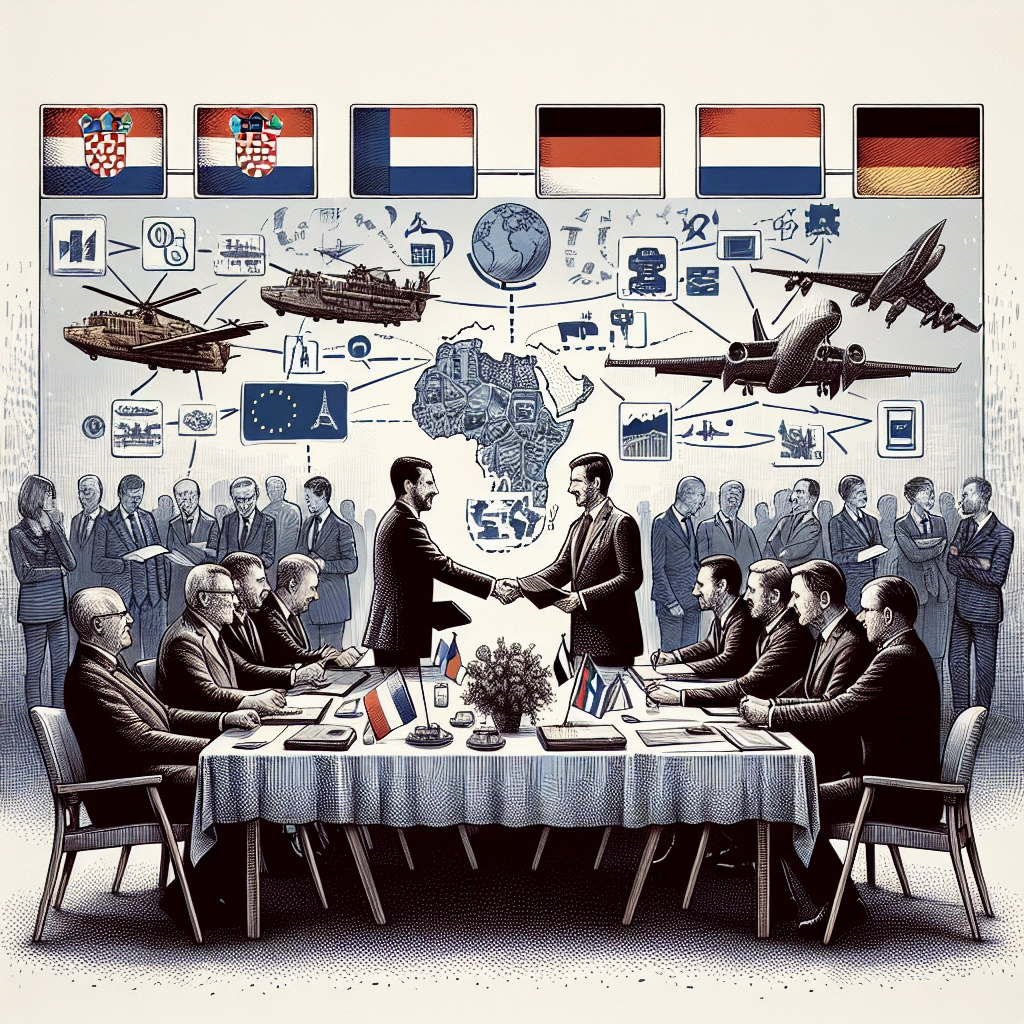
The political delegation includes key members of the Croatian government: Defence Minister Ivan Anušić, Foreign and European Affairs Minister Gordan Grlić Radman, Economy Minister Ante Šušnjar, and Culture and Media Minister Nina Obuljen Koržinek, as well as the Chief of the General Staff of the Croatian Armed Forces, Tihomir Kundid.
At the same time, Croatia is using the trip to promote its civil and defence industries. Business forums will be held in both capitals, organised on the Croatian side by the Croatian Chamber of Economy (HGK). Different sources describe the Paris and Berlin delegations as among the strongest Croatian business missions abroad so far.
More than 30 Croatian companies are expected in Paris and over 50 in Berlin. Participants include some of Croatia’s largest firms, such as Končar (energy and transport equipment), Đuro Đaković (engineering and defence), Dalekovod (infrastructure), Ericsson Nikola Tesla (telecommunications), Podravka (food industry), Adris (tourism and investments), HEP (national energy company), Infobip and Span (IT services), as well as defence producers like DOK-ING and HS Produkt. High‑profile technology companies Rimac Technology and Bugatti Rimac, known for electric hypercars, are also on the list.
On the French side, around 20 major companies have reportedly expressed interest in meetings, including large industrial and high‑tech groups such as Airbus, Alstom, Vinci Energies, Suez, Thales and Vallourec. In Germany, expected partners range from engineering and energy firms to numerous ICT and machine‑building companies. Croatian participants there will include businesses like Siemens’ Croatian branch, EL Sun Energy, machine manufacturers and representatives of the Uljanik shipyard from Pula.
Trade data underline why these two countries are central to Croatia’s foreign economic policy. Germany has for several years been Croatia’s largest foreign trade partner, with imports and exports both growing faster than average. In the first eight months of the current year, Croatian exports to Germany were reported at around €2.1 billion, while imports reached roughly €4.8 billion. France ranks somewhat lower overall but remains an important partner, particularly after Croatia’s previous acquisition of Rafale fighter jets. In the same period this year, imports from France were close to €400 million, while exports to France reached about €1 billion, according to Croatian figures.
Supporters in government and business circles present the upcoming visits as a way for Croatia to move from being only a buyer of foreign military equipment towards becoming a more integrated partner, including potential industrial cooperation and technology transfer. The presence of many energy, IT, food, tourism and logistics companies suggests that the authorities want to use the defence contracts to open doors for broader economic projects.
Critics and sceptical commentators, where they appear in Croatian public debate, often focus on the high cost of rearmament and on whether the country’s limited budget should prioritise social or civilian infrastructure instead. Others question the long‑term sustainability of relying on imported high‑tech systems. These concerns are not dominant in the official communication around the visit, but they form part of the domestic context in which the agreements will be discussed.
For international observers and learners of Croatian, the development illustrates how a smaller EU member state uses defence modernisation not only to renew its army but also to strengthen diplomatic relations and promote its national industry within the wider European framework.
Info: ‘Croatian Learner News’ is a service from ‘Let’s Learn Croatian’, a language school dedicated to teaching Croatian through various types of online courses as well as our summer school in Croatia.
Advanced: Reports from Croatia
- Military Deals with Paris and Berlin: Croatia Isn’t Just a Buyer Anymore (Poslovni.hr)
- Croatia Rearms: Buying French Howitzers and German Tanks (Dnevnik.hr)
- Next Week: Contract Signing for Procurement of Caesars and Leopards (Index.hr)
- Croatia to Acquire New Howitzers and Leopard Tanks as Plenković Heads to Sign Contracts (Net.hr)
Croatian Learner News
Discover news from Croatia to stay informed and practise your skills.
-
Learner News | 07.04.2026
Croatia raises fuel prices while extending tax cuts
-

Learner News | 05.04.2026
Croatian Leaders Issue Easter Messages Amid Global Tensions
-

Learner News | 24.03.2026
Queues at Croatian Petrol Stations Before Price Hike