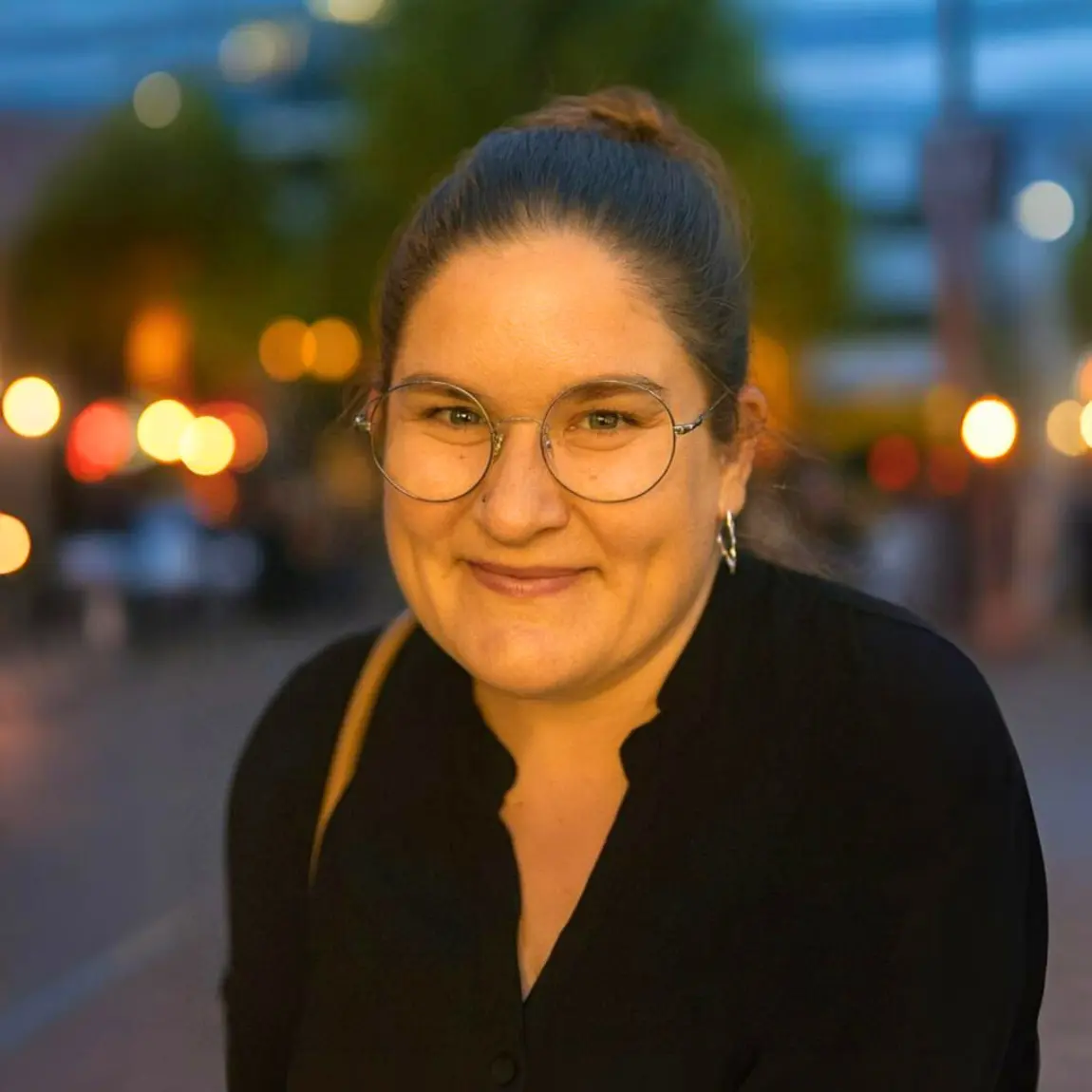
A journalist who follows the story wherever it leads
Tanja has spent her career going where the story is. As a video journalist for Hessischer Rundfunk in Frankfurt, she shoots, edits and presents her own travel reportages – a combination of roles that has taken her from the United States to Morocco to, repeatedly, Croatia. She describes each trip as somehow particular, which makes ranking them nearly impossible. Filming in Croatia, she says, has always felt like something more than work. But her journey to Morocco last year offered something entirely different.
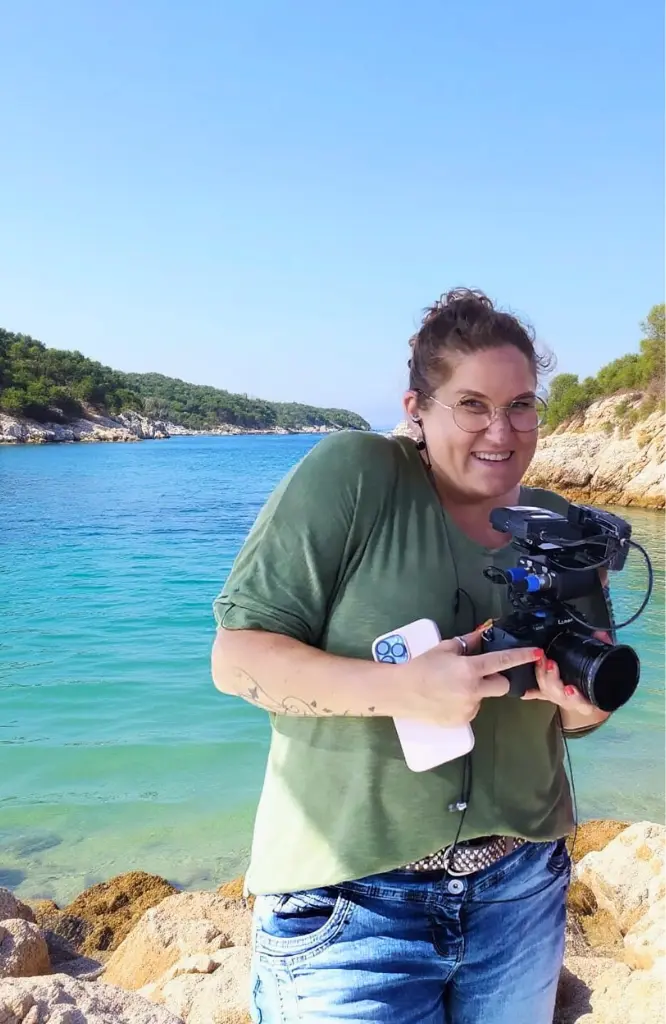
“Filming in Croatia – it barely feels like work.”
Morocco was the trip that tested her most. She and her colleague had seen the weather warnings before heading into the desert, but rain in the Sahara seemed unlikely to amount to much. It did. Severe flooding in September turned the desert floor into a torrent, their camp had to be evacuated, and the two of them had to trust their local Jeep driver completely – in the dark, across terrain that looked, to them, identical in every direction. She recounts it with a kind of earned calm: frightening while it happened, but also a reminder that travelling with someone you trust, and relying on people who know the land, is what keeps you safe. She has come to believe that the best thing travel produces is not footage but friendships – among them a woman named Marina in Pula, her protagonist from her first Croatian reportage, whom she still visits whenever she is in Istria.
A family history written in two languages
Tanja’s connection to Croatia is not the straightforward kind. Her mother was born in Josipovac, near Osijek – a village that was once called Josefsdorf, and where the gravestones in the local cemetery are still largely in German. Her family are Donauschwaben: ethnic Germans who had settled in the region across generations, and who, after the Second World War, were interned, dispossessed, and eventually displaced. Her grandmother survived the camps, as she always said, as if by a miracle. When the family eventually left for Yugoslavia, Tanja’s mother arrived in Germany aged seven without a word of the language.
It is a history that Tanja carries carefully. She is aware that Croatians sometimes find her claimed connection to the country hard to place – she is not Croatian in the conventional sense, and her family’s language at home was German. But the emotional weight of that heritage has only grown as she has got older. Her grandmother, who died when Tanja was in her mid-thirties, used to switch into Croatian the moment she ran into an acquaintance on the street – and an entire community from Josefsdorf had, improbably, reconvened in Obertshausen, the town where Tanja now lives. Croatian was the sound of her family. She just could not speak it.
A surprise journey and the family that was waiting
When her grandmother died, Tanja felt something loosen in the family’s connection to Croatia. Her grandmother’s half-brother had never left – he stayed, married, and now has children and grandchildren of his own in Josipovac. Her mother began to speak about the south with a resigned sigh, as though the visits were already over. Tanja, who describes herself as someone who acts rather than waits, quietly bought plane tickets to Zagreb without telling her mother, informed her of the plan and told her to take a Friday off work.
“I secretly bought the plane tickets. The Croatians taught me what family means. It’s just different there than in Germany.”
She still gets emotional describing what happened when they arrived. In the car, she had been quietly anxious – uncertain how much German the relatives would speak, imagining a polite weekend on someone else’s sofa eating cake. None of that happened. Her great-uncle and great-aunt were standing in the street when the car pulled up, visibly moved, and took them in as though they were children returning home. Inside, there were photographs of Tanja’s communion and her first day of school – sent over the years by her grandmother, and kept. She cried when she had to leave, which she had not expected at all.
Ten years of Croatian, with interruptions
That trip, in her mid-thirties, was the beginning. She started Croatian lessons soon after, driven partly by the desire to understand her cousin – a funny man whose jokes always made the whole room laugh, and which she could never follow. Progress, however, has not been linear. She has been learning, on and off, for roughly ten years, cycling through starts and stops at the Frankfurt Volkshochschule before eventually finding her way to Let’s Learn Croatian. The VHS experience frustrated her: the teacher was enthusiastic but unqualified in language pedagogy, and a significant portion of each lesson drifted off-topic. Tanja redid levels, stopped, started again.
What changed with individual online lessons, she says, is the flexibility. Her work schedule is genuinely unpredictable – she might be away filming for two weeks at a time, with no notice – and a fixed group class simply does not fit her life. One-to-one lessons with Croatian teachers based in Croatia have suited her far better. She has now had four teachers at the school: Valentina from Đakovo, whom she met for coffee when she was visiting Osijek and describes with great warmth; Petra, who was strict in a way Tanja still seems slightly awed by; Maria from Šibenik; and now Luna. Each has been flexible enough to revisit grammar points on request, which matters to her – she is, by her own admission, a perfectionist who would rather slow down and get the endings right than push forward and guess.
Free 6-week email course
Just starting with Croatian? Get one easy lesson per week plus a short exercise to help things stick. Sign up now to begin your Croatian journey!
Sign up for freeFree 6-week email course
Enter your email and we'll send one short lesson a week — straight to your inbox.

Music, family and the long game
Her one piece of advice for anyone starting Croatian is to listen to music. Her own current obsession is Matija Cvek, whose concerts she has attended in Croatia – including one at an open-air venue in Dubrovnik with the sea behind the stage, which she describes as genuinely dreamlike. She finds that hearing lyrics repeatedly gives her phrases that bypass the usual mental machinery: “kuća pored mora” is something she no longer has to think about, because she has heard it so many times that it simply arrives. It is a different kind of learning from grammar tables, and for her, a necessary complement to them.
“Listening to music helps – eventually the words just come.”
Ten years on, Tanja has not given up on Croatian. She tells other families – Croatian, English, American, it does not matter – to pass their languages on to their children, every time the subject comes up. She wishes her own mother had. Her mother still speaks some Croatian, insisting it is “very poor” while apparently understanding rather more than she lets on – but the two of them have never managed to hold a conversation in it. That remains unfinished business. In the meantime, Tanja keeps booking lessons around her schedule, keeps visiting Josipovac, and keeps listening to Matija Cvek. The language that was always around her is, slowly and stubbornly, becoming hers.
Teacher and student stories
Discover inspiring language journeys and see how others are learning and teaching Croatian.
Stan | Student
After 25 years of visits and a repertoire limited to Croatian curse words, this New York journalist finally tackled the language properly.
Magdalena | Teacher
An Economics student from Vrsari who learned languages through cartoons and tourism finds her calling teaching Croatian from her Rijeka flat

Lisa Marie | Student
Lisa Marie learns Croatian to connect with her heritage, communicate during holidays, and honour her brother’s memory.