
Trading Frankfurt for Greek island life
When Susanne met her Austrian-Greek husband seven years ago, neither of them expected to end up in Thessaloniki, a Greek town far from both their home countries. For four years, they shuttled between Frankfurt and Austria, but when it came time to choose where to settle, they surprised themselves by picking Greece. At 49, Susanne left behind her German city life to work as a virtual assistant from home, trading her cycling hobby for island hopping and learning to navigate Greek markets for fresh ingredients.
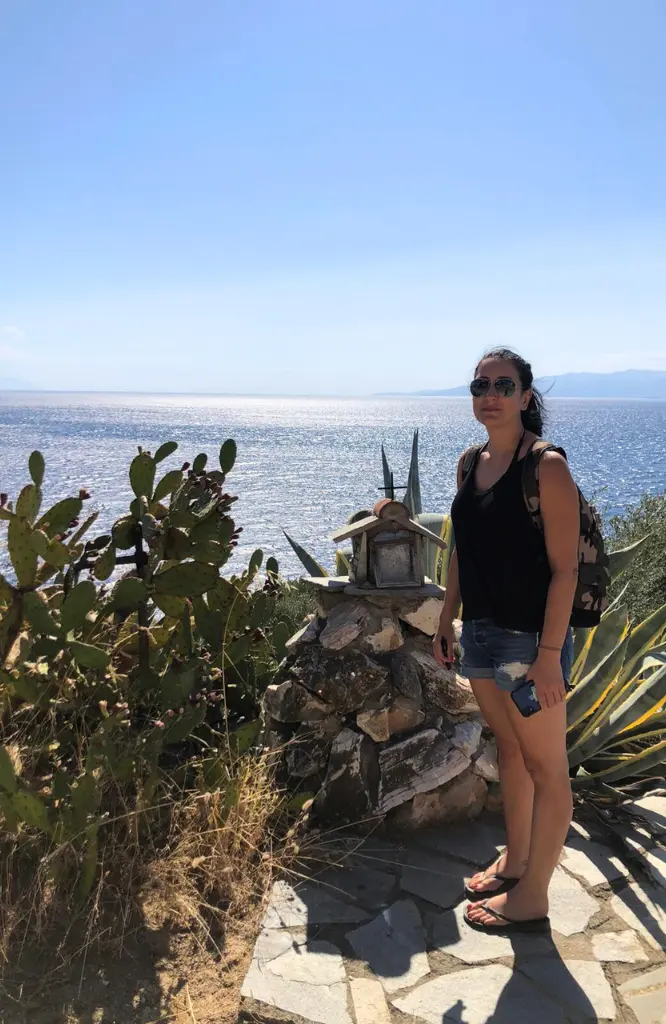
“When I first saw the alphabet, I thought: you’ll never manage this.
It’ll never work.”
The transition revealed unexpected differences. “I thought people would be so open and friendly and welcoming, and everyone thinks that’s wonderful,” she reflects, “but I find that people here are very family-oriented.” Coming from a large German city where people easily socialise outside their immediate circles, she noticed how Greek social life centres around long-standing friendships and family bonds. Yet the trade-off brought its own rewards – the traditional celebrations, the unhurried pace, and the islands like Chios, still untouched by mass tourism, where she found the quiet authenticity she prefers.
The long search for the right method
Six months before moving to Greece, Susanne started learning Greek at a language school in Frankfurt. It didn’t go well. The pace was relentless, and between work commitments and the pressure to keep up, she felt herself falling behind. The alphabet, which initially seemed impossible, turned out to be easier than expected – but the teaching approach wasn’t right. She left that school and tried online lessons instead, then enrolled in a year-long programme in Thessaloniki where she completed two exams before returning to online learning.
Each attempt brought the same frustration: she wasn’t making real progress. Working from home all day meant limited contact with Greek speakers, and whilst her husband’s family lived nearby, their rapid-fire conversations left her struggling to follow. She even tried learning with a Greek friend, but that didn’t work either. “I spoke with friends recently,” she says, “and we agreed that you have to search for a very long time until you find your teacher. And then it fits.”
When traditional teaching works best
What finally worked was surprisingly traditional. Vocabulary lists. Homework assignments. Regular testing. “I think many courses believe they need to follow special concepts,” Susanne explains. “Here with you, I find it’s still very classical. I get tested on vocabulary, I get homework that I have to do. So I always have this push that I need to do something now.” Rather than relying on self-motivation alone, having a Tuesday deadline creates the structure she needs – vocabulary must be learned, homework must be completed, because class is coming.
“Most say, ‘You need to know how much you want to learn.’ Then you have no time and you keep postponing. But this way it’s always Tuesday, class day.”
The approach extends to conversation practice as well. Instead of immediate corrections that derail her train of thought, her teacher gives her time to catch her own mistakes. “Usually you notice five seconds later – ah, there was an error – and then you correct yourself,” she notes. That patience makes all the difference. Immediate corrections create a cycle of hesitation and withdrawal, but this method builds confidence. When she struggles with reading comprehension exercises at home, class time becomes a guided journey where she discovers she can work out unfamiliar words through context and structure. “You only get that in individual lessons,” she says, “someone leading you through, taking you by the hand, and then somehow you figure it out yourself.”
That first real conversation
The breakthrough came unexpectedly in Frankfurt. Susanne was visiting friends, waiting at an outdoor café when she heard Greek spoken behind her. She turned to find a young couple and struck up a conversation. They were both learning German; she was learning Greek. When vocabulary failed them, they could translate for each other, creating an impromptu language exchange that worked both ways. “That was the first time I really spoke,” she recalls. “It was fantastic.”
Daily life in Greece presents ongoing challenges she’s still working through. Doctor’s appointments with non-German-speaking physicians, physiotherapy sessions where she can’t explain what hurts, administrative tasks that require more than basic phrases – these remain difficult. There’s also the unexpected problem of Germans everywhere. Her hairdresser speaks German. Former guest workers and their children speak German. People automatically switch to English. “What’s also difficult, which I still need to sort out, is that people here come at you with English,” she says. “Then you have to say, ‘I don’t speak English, speak Greek and very slowly.’”
Already know some Greek?
Take our free placement test and find your current level in just a few minutes. It’s fun, fast, and helps you understand exactly where you are – and what the next step in your learning journey might be.
Take the free test
The long game of language learning
Susanne admits giving advice about learning Greek feels strange when she’s still struggling herself. Everyone comes from different circumstances – the person learning casually for their holiday home has different needs than someone who must navigate daily life in Greek. But one lesson stands clear from her experience: don’t waste time with the wrong teacher. “I spent an enormous amount of time in the wrong place for me,” she reflects. Finding the right learning style and the right person to teach it matters more than any special methodology.
“If I stopped now, I’d regret not finishing it.
I’d be crying about giving up on learning.”
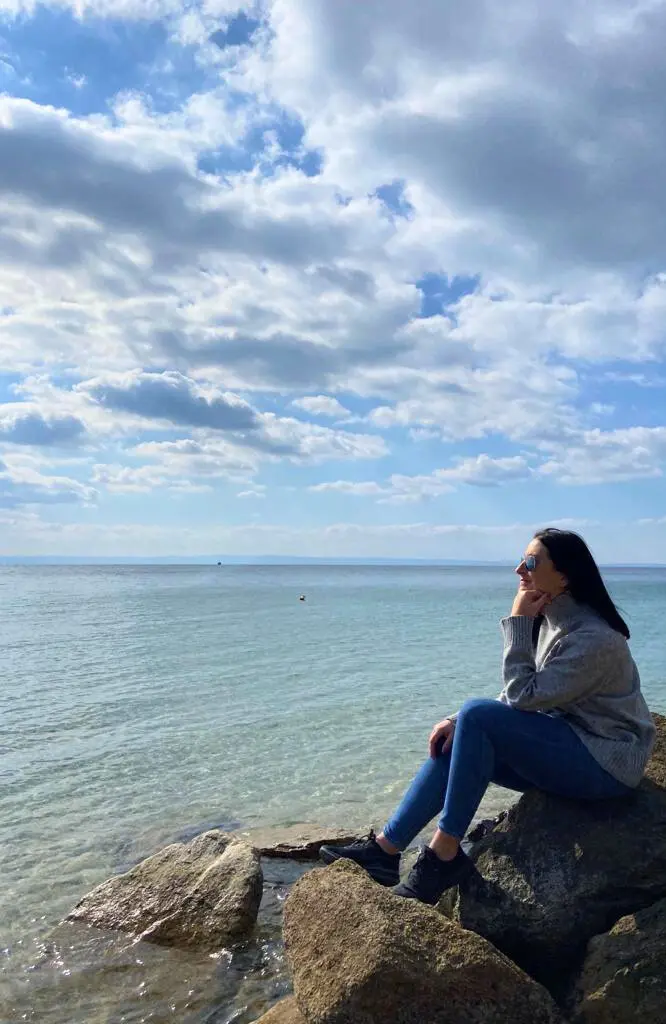
She keeps going because the alternative is unthinkable. The motivation is always there, just ahead – the ability to handle those doctor’s appointments alone, to chat naturally with her husband’s family, to feel at home in the language of her adopted country. Reading Greek comes easily now. The radio, the news, the supermarket flyers – she’s surrounded by the language constantly. The speaking will come. She just needs to keep showing up every Tuesday, doing her vocabulary drills, and giving herself time to find those words that are waiting just on the edge of her awareness, ready to emerge when she stops trying quite so hard to force them out.
Teacher and student stories
Discover inspiring language journeys and see how others are learning and teaching Greek.

Antonia | Student
From understanding nothing in Greek supplier meetings to building genuine connections through language learning.

Mirjam | Student
Mirjam balances a demanding career and family life whilst learning Greek – motivated by love, driven by curiosity about linguistic connections.

Nikos | Teacher
From online markets to ancient texts, Nikos shows how 4,000 years of Greek culture still shape modern-day conversations.