
The news in Greek
- έκρηξη (f.)
ξαφνική και δυνατή απελευθέρωση ενέργειας που προκαλεί θόρυβο, φωτιά ή καταστροφή ↩︎ - αρχή (f.)
οι δημόσιες υπηρεσίες και οι υπεύθυνοι οργανισμοί που διοικούν και ελέγχουν κάτι ↩︎ - έρευνα (f.)
συστηματικός έλεγχος ή μελέτη για να βρεθεί η αλήθεια ή νέες πληροφορίες ↩︎ - ιδιοκτήτης (m.)
άτομο που έχει κάτι δικό του, που το κατέχει νόμιμα ↩︎ - ανακριτής (m.)
δικαστικός υπάλληλος που ερευνά εγκλήματα και παίρνει καταθέσεις ↩︎ - ασφάλεια (f.)
κατάσταση όπου δεν υπάρχει κίνδυνος ή μέτρα που προστατεύουν από τον κίνδυνο ↩︎
Translation
Text comprehension
Question 1: What serious event happened at the biscuit factory in Thessaly, and what was the result for five women?
Question 2: Why was the second factory of the same owner closed by the authorities?
Vocabulary
| Greek | English |
|---|---|
| έκρηξη (f.) | |
| αρχή (f.) | |
| έρευνα (f.) | |
| ιδιοκτήτης (m.) | |
| ανακριτής (m.) | |
| ασφάλεια (f.) | |
Practise Greek for free
Use our interactive study tool to improve your Greek with vocabulary quizzes, grammar exercises, and progress tracking. Pick a topic, start a quiz, and see how your skills grow over time.
Try the study tool
Read the full story
Greek authorities have temporarily shut down a second biscuit factory linked to the Violanda company owner, as investigations continue into the deadly explosion at the firm’s main plant in Trikala, central Greece.
The owner of Violanda has been called to appear before an investigating magistrate in Trikala. He faces serious criminal charges, including allegations of negligence with possible intent in connection with the explosion that killed five female workers. His lawyers are expected to request a 24- or 48-hour extension to study the extensive case file, which reportedly contains around fifty witness statements, expert reports and video and photo material collected by the Fire Service’s arson investigation unit.
According to Greek media, the owner plans to argue that he followed the law and that responsibility should be shared with engineers and technical consultants who signed off on studies and permits for the plant’s installations. His defence is expected to highlight the role of the surveyor who did not declare the basement, and of mechanical engineers who approved the installation of gas pipelines in the basement area without all the legally required safety safeguards.
In parallel with the explosion inquiry, authorities are now examining the owner’s other businesses. Over the weekend, a member of the public reported unusual excavation works at another factory site belonging to the same entrepreneur but operating under a different tax number. Police went to the site and, by order of the public prosecutor, all works were stopped.
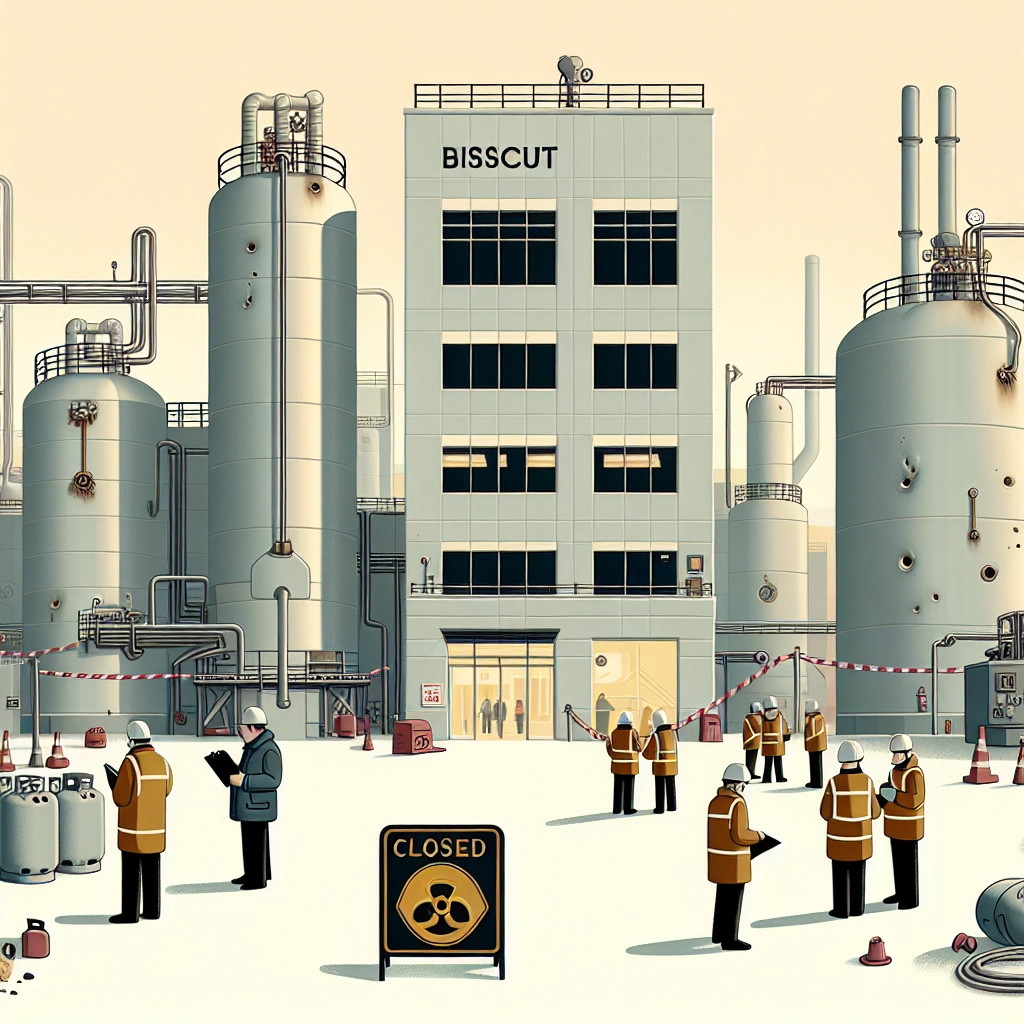
On Monday, inspectors from the Region of Thessaly and the Fire Service carried out a safety inspection at this second plant, known commercially as VITAFREE – Hellenic Biscuit Industry S.A., located near the village of Taxiarches on the Trikala–Larissa national road. The regional authority then issued a decision to temporarily suspend its operation, specifically shutting down the production lines and the liquefied gas installations.
The official decision states that there was an “immediate risk for the safety of the installations and workers” because the factory did not have valid inspection certificates for the gas tanks and lacked both a fire protection certificate and proof that a fire safety study had been properly filed. Under Greek industrial legislation, this allowed the region to order a temporary halt under Article 29 of Law 3982/2011. The company has the right to appeal the decision within fifteen days.
The second factory had earlier announced that it would not operate on Monday in order to carry out “external technical works”. However, regional officials concluded that the safety documentation was insufficient and decided to impose the suspension for preventive safety reasons.
Back at the main Violanda plant in Trikala, the criminal case has entered the phase of the formal judicial investigation. The file is now in the hands of the chief prosecutor of Trikala, who will decide which directions the investigation should follow and which additional witnesses must be called to clarify how the factory operated in practice.
Testimonies collected so far suggest that the factory management had received two offers from technical consultants to improve potential weaknesses in the gas installation. According to these accounts, the company did not proceed, reportedly due to the cost of the works and the need to shut down production for about a week. These claims will be examined further as the investigation continues.
Experts are also assessing the possible technical causes of the accident. Retired Fire Service lieutenant general and chemistry professor Michalis Chalaris told Greek public television that the propane leak appears to have occurred at a rate that was not detected by the tank’s safety valve, exposing a serious safety gap. He also pointed to questions about the way the pipeline was installed and whether it had sufficient protection and correct materials.
Chalaris argued that the incident should serve as a case study for revising Greece’s rules on piping and distribution systems for propane, liquefied petroleum gas and butane. He called for an “holistic” update of national legislation, including modern sensors and monitoring systems capable of detecting even minimal gas leaks. According to him, the existing legal framework on such installations is considered outdated.
Families of the victims are following the legal process closely. Lawyer Christos Patounas, who represents some of them, stated that they are now gaining full access to the case file for the first time. He referred to documents published on the government transparency website Diavgeia, which, he said, indicate that the Trikala plant had only a temporary operating licence issued in February 2020 for a period of two years.
That licence reportedly required the company to move its gas tanks two metres further away from the property boundary, from 5.5 metres to 7.5 metres. Patounas claims that this relocation and a related replacement of corroded pipelines never took place, and that no extension, renewal or official termination decision for the licence appears publicly on Diavgeia after February 2022. He argues that if the conditions had been met, the accident might have been avoided, but stresses that his conclusions remain subject to confirmation from the full court file.
Patounas also raised questions about the role of the local development authority in Trikala, which granted the temporary licence and, in his view, should have taken further action once the two-year period expired. According to Greek administrative rules, failure to meet the licence conditions can lead to partial or total suspension of operations. Whether and how these procedures were followed is now part of the broader investigation.
As the owner prepares to testify and inspections expand to other plants, Greek prosecutors, technical experts and lawyers are trying to piece together how safety rules were applied in practice and whether deficiencies in oversight, engineering or company decisions contributed to the fatal explosion. Final conclusions will depend on the outcome of the judicial investigation and the technical reports that are still in progress.
Info: ‘Greek Learner News’ is a service from ‘Let’s Learn Greek’, a language school dedicated to teaching Greek through various types of online courses, where we share practical tips on how to learn Greek fast and build steady progress over time.
Advanced: Reports from Greece
Greek Learner News
Discover news from Greece to stay informed and practise your skills.
-

Learner News | 11.05.2026
Nationwide public sector strike in Greece 13 May
-

Learner News | 10.05.2026
Metallica electrify Athens’ OAKA Stadium after 16 years
-

Learner News | 25.04.2026
Greece and France Sign New Defence, Energy Pacts