From backpacking dreams to European roots
Maria’s career path led her from Germany’s southern Bodensee region to Munich, where she works as a marketing manager in the healthcare sector, creating advertising for software and hardware products. It wasn’t quite the international role she’d dreamed of – one that might have taken her to different company locations around the world. For years, she channelled that wanderlust into extensive backpacking trips across Asia, spending roughly eighteen months travelling through Vietnam, Thailand, Canada, Australia, New Zealand, and Indonesia. She even completed yoga teacher training in Indonesia, adding another dimension to her passion for movement and mindfulness.
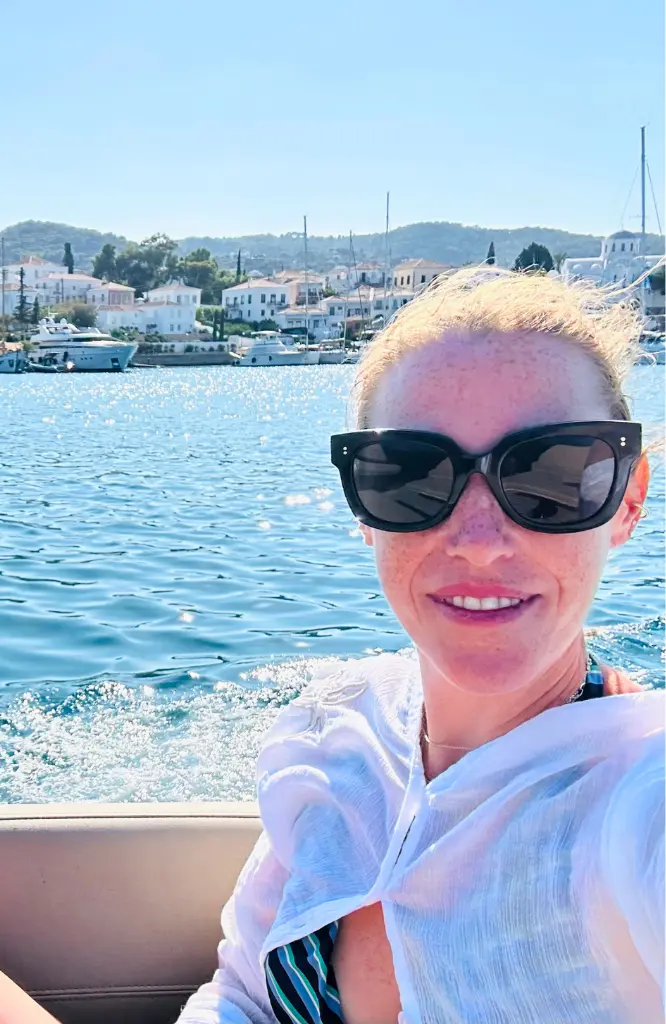
“I always thought Europe was something I could do later, but now I see how beautiful Greece truly is.”
But recently, her perspective on travel has shifted. Through her Greek partner and his mother, who lives in Athens, Maria has discovered that Europe – a continent she’d always thought she could explore “when I’m older” – holds its own compelling attractions. The Greek islands, she’s found, rival anything Asia has to offer. The sea is even more beautiful, she admits. What began as visits to her partner’s family has evolved into something deeper: a genuine appreciation for Greek culture and a desire to become part of it.
Love and belonging in a blended family
Maria’s partner is Greek, and his three half-Greek children became the catalyst for her decision to learn the language. It wasn’t about practicality or career advancement – it was about belonging. She wanted to feel more connected to this family she was becoming part of, to understand the culture that shaped her partner’s past, and to participate more fully when visiting relatives in Greece. For her, learning Greek felt like a natural extension of commitment. When you’re with someone from another country who speaks another language, she believes, learning that language creates a beautiful shared connection – not just with your partner, but with their children too.
The response from her partner’s family has exceeded her expectations. Every Tuesday, when she says she can’t make plans because she has Greek class, they express pride in her dedication. The children are particularly encouraging, constantly telling her they believe in her. Even when she’s far from fluent, the positive feedback she receives makes the effort worthwhile. It’s exactly what she’d hoped for when she started – a way to grow closer together. Her partner happily helps with pronunciation, and while speaking Greek at home is still a distant goal, she’s learning to take it step by step, knowing that small progress leads to bigger achievements.
The reality check of a beautiful challenge
Maria admits she initially thought learning Greek would be easier. She’d been captivated by Greek music – its emotional depth, dramatic flair, and warm-heartedness that mirrors the Greek people themselves. The language drew her in with the same intensity. But once she began studying properly, reality set in. Unlike German, Greek offers no familiar reference points, no cognates to rely on. The alphabet, pronunciation, and grammar are entirely foreign territory. Reading and writing present their own challenges.
“I thought it would be easier, but having no connections to German makes it genuinely difficult. What motivates me is the positive feedback when I manage even a few words.”
Yet this difficulty is precisely what makes the small victories so satisfying. Maria doesn’t consider herself particularly gifted with languages, but she has discipline and strong motivation. When she’s with her partner and the children, she understands more and more, even if she can’t yet speak fluently. She grasps contexts and connections. These moments of comprehension feel like genuine returns on her investment of time and energy. In Greece, when she manages a few simple sentences, she can see how much it means to people that she’s making the effort to learn their language. That reciprocal appreciation, she’s discovered, is what keeps her going through the challenging bits.
Finding community in weekly lessons
Maria started with just the Mondly app, which she still uses, but joining Let’s Learn Greek transformed her learning experience. She’s been meeting with the same small group of four women from different German cities for seven months now, and they’ve genuinely become a community. They explain things to each other during lessons, help one another, and support each other’s progress. It’s not competitive like school sometimes was – there’s no sense of anyone trying to be better than anyone else. Everyone shares the same goal of learning the language, and they celebrate each other’s progress.
The dynamic is refreshingly collaborative. Between classes, they check in with each other about continuing together to the next level. When someone misses a session and falls behind, the others offer understanding rather than judgement. Maria appreciates the ability to review recorded lessons if she was ill or simply having an off day. What she values most is learning practical, everyday vocabulary and phrases first – the kind that produces those small victories when you realise you can actually use what you’ve learned. Her teacher provides direct feedback, helping Maria track her progress. Things that seemed impossible at the start, like reading Greek script, now feel manageable. She can understand context even when she doesn’t know every word. The best part, she reflects, is that no one takes it too seriously. Everyone still enjoys the process.
Practise Greek for free
Use our interactive study tool to improve your Greek with vocabulary quizzes, grammar exercises, and progress tracking. Pick a topic, start a quiz, and see how your skills grow over time.
Try the study tool
Building a sustainable practice
Grammar remains Maria’s biggest challenge, particularly articles – knowing when to use which one. She has moments where everything clicks and flows smoothly, then periods where she feels she’s forgotten everything. The different tenses will be interesting, she says with some humour, though she supposes one could always just speak in the present tense as a workaround. But the real challenge isn’t the grammar itself – it’s staying engaged, consistently learning vocabulary, and recognising that taking a weekly class is only part of the equation. You need to invest time outside lessons too, especially with a language you don’t hear on the radio or television.
“We’ve become a small community. We all have the same goal, and we genuinely want each other to succeed.”
Maria’s developed her own system. She always carries flashcards, reviewing them on the U-Bahn to work or on trains. She reads along with Greek song lyrics on Spotify, watching how words are emphasised and pronounced. She’s cut out grammar explanations from her course materials and organised them in a separate binder for easy reference – a project manager’s approach to language learning. In daily life, she mentally translates everyday objects: salt, “do you have”, and other common phrases. It’s her way of keeping the language present even when she’s with her parents, who don’t understand Greek. She’s found that what worked for her in school still works now – everyone needs to remember their own best learning methods. For Maria, it’s flashcards, learning whilst walking, and trying to apply things in practical contexts. The key is maintaining motivation and not feeling overwhelmed by all the materials. Take them bit by bit, she advises, and remember why you wanted to learn in the first place.
Teacher and student stories
Discover inspiring language journeys and see how others are learning and teaching Greek.

Christian | Student
As his son grows fluent, Christian finds new meaning in Greek – bridging cultures one bedtime phrase at a time through fatherhood.

Maja | School manager
Maja combines theatre and teaching to create a safe space where students can explore Greek – and discover themselves too.

Julia | Student
Julia traded scattered holiday phrases for structured Greek lessons, finally connecting properly with her father’s heritage